
Balanced Advantage Funds: Who Should Invest

Most mutual fund investors know they’re supposed to rebalance their portfolio when the market moves too high or falls sharply. Almost nobody actually does it.
Balanced Advantage Funds also called Dynamic Asset Allocation funds do the rebalancing for you. They move money between equity and debt based on market valuations, so you don’t have to watch the Sensex every week and make a judgment call. If you’re just getting started with how SIPs work, a BAF can be a useful next step once you’re comfortable with the basics.
With the category now managing close to ₹3 lakh crore (AMFI, September 2026), BAFs are clearly popular. HDFC Balanced Advantage Fund alone crossed ₹1 lakh crore in AUM the second actively managed scheme to do so after Parag Parikh Flexicap.
But before you invest in any BAF, there’s one thing most beginner guides skip: not all BAFs work the same way. Two funds in the same category can behave completely differently in the same market and that matters for your money.
What is a Balanced Advantage Fund?
A Balanced Advantage Fund is an open-ended equity-oriented hybrid fund that adjusts its equity exposure dynamically. When the market looks expensive, it reduces equity and moves more to debt. When valuations look cheap, it increases equity.
SEBI defines this category as a Dynamic Asset Allocation or Balanced Advantage Fund. There’s no fixed equity range — the fund manager has full flexibility to move between asset classes based on the fund’s internal model.
For tax purposes, most BAFs maintain at least 65% equity exposure (including equity derivatives), which means they’re treated as equity funds. This gives investors long-term capital gains taxation of 12.5% on gains above ₹1.25 lakh after 12 months the same treatment you get from a pure equity mutual fund.
How does a BAF decide how much equity to hold?
This is the part most articles gloss over. BAFs use internal models to decide their equity-debt mix, and these models are not standardized. There are two main approaches:
Valuation-led (contrarian) models
These use metrics like Price-to-Earnings (P/E) ratio or Price-to-Book (P/B) ratio to judge whether the market is expensive or cheap. When valuations are high, they cut equity. When valuations fall, they add equity.
HDFC Balanced Advantage Fund and ICICI Prudential Balanced Advantage Fund use this approach. A Business Standard analysis (June 2025) noted that valuation-led BAFs tend to lower volatility at the cost of potentially lower returns in strong bull markets — because they reduce equity exposure while prices are still rising.
Momentum-led (trend-following) models
These follow the market trend rather than fight it. If the market is going up, they stay heavily in equity. If momentum turns negative, they move toward debt.
Edelweiss Balanced Advantage Fund is a prominent example of a momentum-led BAF. These funds can capture more upside during a bull run but may also stay exposed longer when markets peak.
Why this matters: Two BAFs can hold completely different equity allocations in the same market. One might be at 30% equity when another is at 75% — both following their stated mandate. If you pick a BAF purely on past returns without understanding its model, you may end up with a fund whose behavior surprises you when markets get turbulent.
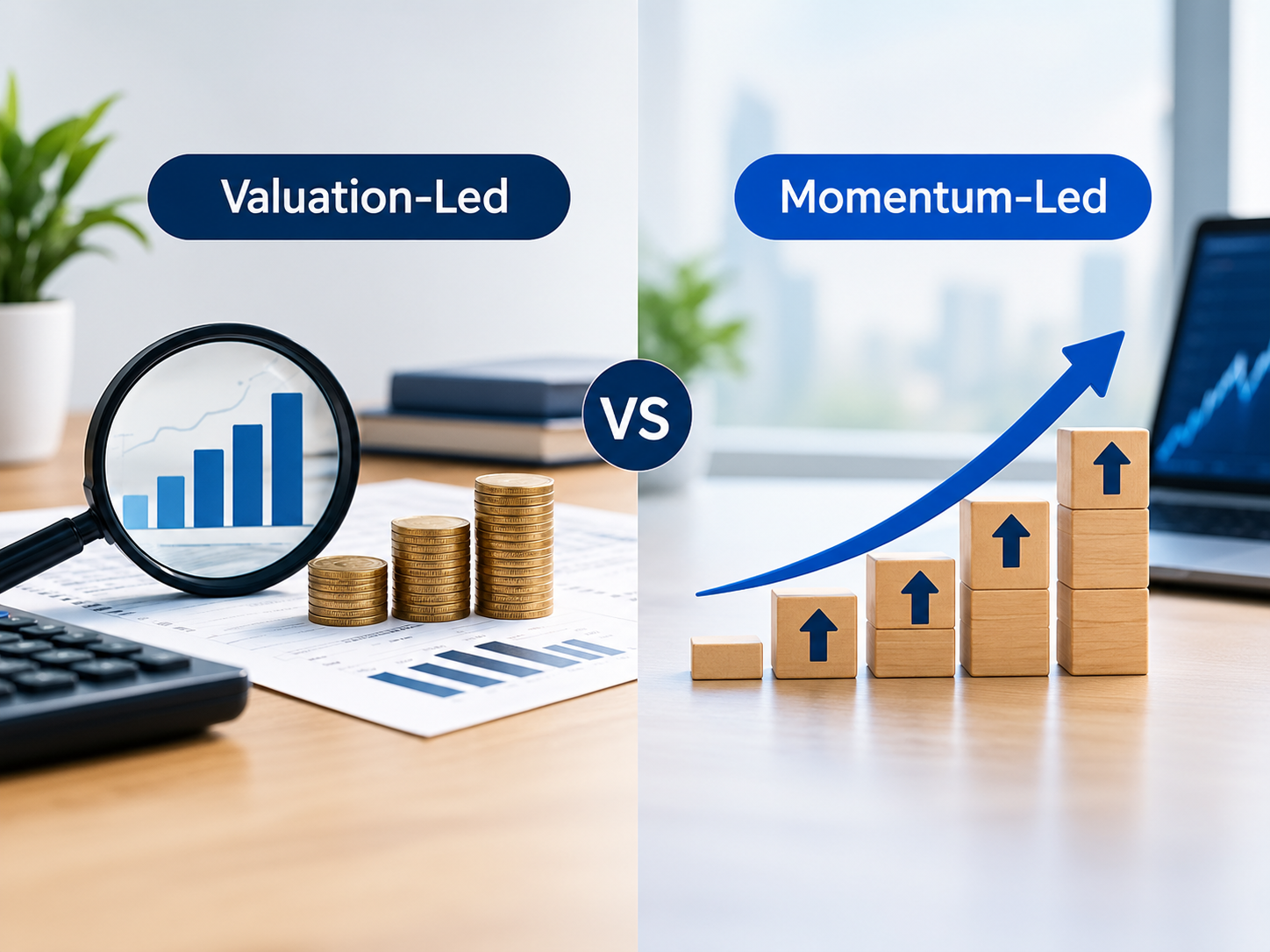
Image Source : AI
Returns: what the numbers show
Returns vary by fund and by market period. Here are the trailing returns for two of the category’s largest funds as of October 2026 (Source: Value Research, October 2026):
| Fund | AUM (Sep 2026) | 3-Year Return | 5-Year Return |
| HDFC Balanced Advantage Fund | ₹1,02,533 crore | 9.66% | 15.57% |
| ICICI Pru Balanced Advantage Fund | ₹75,399 crore | ~10.43% (category avg) | 12.2% |
Past returns are not a guarantee of future performance.
The 5-year return for HDFC BAF is strong, but much of that reflects market conditions from 2019–2021 where the fund’s equity allocation decisions played out well. The 3-year number is more modest which is typical for BAFs during steady bull markets where they hold back equity to manage valuations.
A word of caution on back-tested data: many BAFs are relatively recent launches, and their historical performance often includes simulated returns from before the fund existed. Always check the fund’s live track record against its back-tested period before drawing conclusions. Value Research Online clearly marks the inception date for each fund — use that as your starting point.
BAF vs Multi Asset Fund vs DIY allocation
Investors often confuse BAFs with Multi Asset Funds or with simply managing their own equity-debt split. Here’s how they differ:
| Feature | BAF | Multi Asset Fund | DIY rebalancing |
| Asset classes | Equity + Debt | Equity + Debt + Gold (min 10% each) | Your choice |
| Rebalancing | Automatic (model-driven) | Automatic (fund manager) | Manual (you decide) |
| Taxation | Equity (if ≥65% gross equity) | Equity if ≥65%; else hybrid | Each asset taxed separately |
| Gold exposure | No | Yes (mandatory minimum) | Optional |
| Suitable for | Moderate-risk, hands-off investors | Investors wanting 3-asset diversification | Active investors comfortable making allocation calls |
The key difference: BAFs only move between equity and debt. Multi Asset Funds must hold a minimum 10% each in equity, debt, and gold at all times — more diversified but with less tactical flexibility for the fund manager.
Who should invest in a BAF?
A BAF works well for investors who:
- Are moderate-risk investors — not comfortable with 100% equity but also not looking for purely fixed returns
- Know they won’t rebalance on their own — the emotional pull to stay in equities during a bull run, or to flee to debt when markets fall, is real. A BAF forces discipline mechanically.
- Have a 3-year or longer horizon — BAFs are not short-term products. The rebalancing model needs time to work through at least one market cycle.
- Are near or in early retirement — BAFs have historically provided smoother returns than pure equity funds, which matters more when you’re drawing down capital.
- Business Standard (January 14, 2026) specifically recommended moderate-risk investors consider balanced advantage funds as a core holding for 2026, citing the category’s ability to cushion equity drawdowns while still participating in upside.
Who should NOT invest in a BAF?
- Young investors with a 15-year+ horizon and high risk tolerance — a pure equity index fund or diversified active fund will likely generate more wealth over long periods. BAFs trade some upside for smoother volatility.
- Investors who already manually rebalance if you’re actively managing your own equity-debt ratio across separate funds, a BAF adds overlap and may skew your actual allocation without you realizing it.
- Short-term investors — if your goal is under 3 years, look at debt funds, liquid funds, or fixed deposits instead.
- Anyone using a BAF as their only fund BAFs are a good core holding, not a complete portfolio. They don’t cover international equity, gold, or small/mid-cap exposure.
Three things to check before picking a BAF
1. Understand the allocation model
Find out whether the fund uses a valuation-led or momentum-led model. This is in the fund’s Scheme Information Document (SID), available on the AMC’s website or through SEBI’s fund registry. It tells you how the fund will behave during market peaks and corrections — and whether that matches your expectations.
2. Check live track record vs back-tested data
Many BAFs were launched after 2018, and their longer-term return charts include simulated returns from before the fund existed. Use Value Research Online to check the fund’s inception date and identify where live performance begins. A fund with 10 years of ‘back-tested’ history and only 3 years of actual live returns should be evaluated on those 3 live years.
3. Know your total equity exposure
If you hold other equity mutual funds and add a BAF on top, your actual equity exposure may be higher than you think or lower, if the BAF is currently defensive. Review your full portfolio allocation, not just the BAF in isolation.
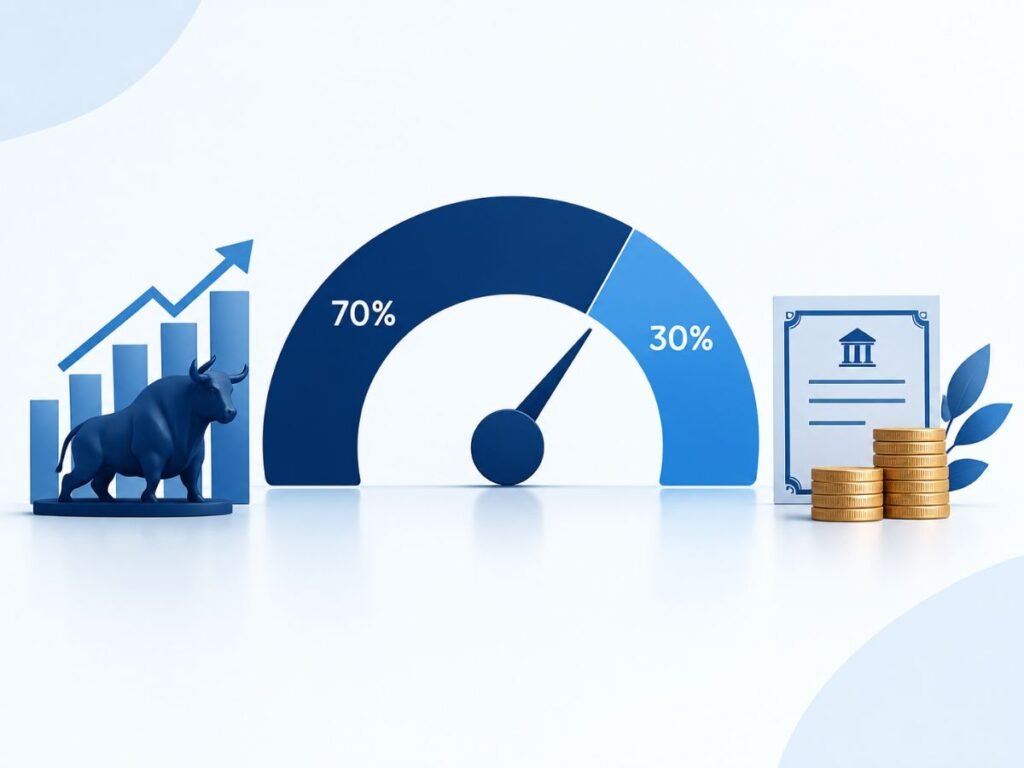
Image Source : AI
Taxation on BAF investments
Most BAFs are structured to maintain at least 65% gross equity exposure (including equity derivatives like futures), which qualifies them as equity funds for taxation purposes under current income tax rules:
Short-term capital gains (held under 12 months): 20%
Long-term capital gains (held over 12 months): 12.5% on gains above ₹1.25 lakh per year
Dividends: Taxed at your income tax slab rate
Check the fund’s SID or ask your distributor to confirm the equity treatment before investing, as some BAFs do dip below 65% gross equity at times.
Common questions
Is a BAF better than a regular hybrid fund?
It depends on what you mean by ‘better.’ Aggressive hybrid funds maintain a fixed equity range (65–80%), while BAFs can move to as low as 20–30% equity when markets are expensive. BAFs offer more cushioning during downturns. Aggressive hybrid funds may outperform in sustained bull markets. Neither is universally better — your risk profile and market outlook matter.
Can I do an SIP in a BAF?
Yes. Most BAFs accept SIP investments. Starting an SIP in a BAF is a common approach for moderate-risk investors who want rupee-cost averaging without the volatility of a pure equity SIP.
How is a BAF different from a balanced fund?
A ‘balanced fund’ (now called an aggressive hybrid fund under SEBI’s classification) maintains a fixed equity range — typically 65–80%. A BAF has no fixed range and can go from 20% to 80% equity depending on its model. The dynamic flexibility is the defining characteristic of BAFs.
What is the minimum investment for a BAF?
Most BAFs accept a lump sum minimum of ₹500 to ₹1,000 and an SIP minimum of ₹500 per month. Check the specific fund’s terms on AMFI’s website or the AMC’s page before investing.
The bottom line
Balanced Advantage Funds solve a real problem: most investors know they should rebalance but don’t. BAFs automate that discipline and take market timing out of your hands.
They’re best suited for moderate-risk investors with a 3+ year horizon who want equity participation with automatic downside cushioning. They’re not the right fit for young long-term investors who can ride out equity volatility, or for investors who are already actively managing their own portfolio balance.
Before picking any BAF, do the three checks: understand the allocation model (valuation-led vs momentum-led), verify how much of the return track record is back-tested vs live, and account for how the fund fits your overall portfolio allocation.
Related reading on NiveshKarlo
If you’re building a portfolio around a BAF, these articles will help you with the pieces it doesn’t cover: Large Cap vs Mid Cap vs Small Cap Funds explains where to put the equity side of your portfolio. Multi Asset Funds covers how adding gold changes the diversification equation. And if you’re still deciding how to invest lump sum or installments How SIPs work is a good starting point.

Hello there, my name is Phulutu, and I am the Head Content Developer at Nivesh Karlo. I have 13 years of experience working in fintech companies. I have worked as a freelance writer. I love writing about personal finance, investments, mutual funds, and stocks. All the articles I write are based on thorough research and analysis. However, it is highly recommended to note that neither Nivesh Karlo nor I recommend any investment without proper research, and to read all the documents carefully.