
Do You Need a Demat Account to Invest in Mutual Funds?

The short answer is No. Here is the longer answer — how mutual funds actually track ownership, what you do need instead, and the one situation where a demat account genuinely matters.
Transparency: AI-assisted draft reviewed by the NiveshKarlo team. All KYC rules, folio mechanics, and SEBI regulations verified August 4, 2026 from SEBI, AMFI, and CAMS. Informational only — not investment advice.
| No. You do not need a demat account to invest in mutual funds. This is also the answer the r/IndiaInvestments community wiki gives — directly, without qualification. Most people asking this question have seen a mutual fund app ask them to open a demat account and assumed it was mandatory. It is not. The confusion exists because the same apps that sell mutual funds also sell demat accounts, and many of them bundle the two together at signup. |
How mutual funds track your ownership — without a demat
When you invest in a mutual fund, the fund house (AMC) assigns you a folio number — a unique identifier that records how many units you own in that fund. Your folio is maintained by the AMC’s Registrar and Transfer Agent (RTA) — either CAMS or KFintech, the two SEBI-registered RTAs that handle record-keeping for most mutual fund houses in India.
This folio system has been in place for decades and is entirely separate from the demat infrastructure used for stocks. Your mutual fund units are held digitally in the AMC’s records under your folio number, linked to your PAN and bank account. You can invest, switch funds, and redeem — all without a demat account.
As of May 2026, there are 27.66 crore mutual fund folios in India — the vast majority of which are held in folio form, not through demat accounts. Every person who has ever invested via a mutual fund app, an AMC website, or through a bank branch without opening a separate demat account is holding their units in folio form. It works.
What you actually need — and what the process looks like
To invest in any mutual fund in India, SEBI mandates KYC (Know Your Customer) verification. This is a one-time process — once done, it applies to all mutual fund investments across all AMCs. You do not repeat it for each fund house.
- PAN card — mandatory for all investors.
- Aadhaar card — for digital KYC (eKYC). If you complete KYC online, a live photo and OTP verification is required.
- Bank account details — a savings account linked to your investments. All redemption proceeds go to this account.
- Mobile number and email — for OTP-based transactions and statements.
That is the complete list. No demat account. No trading account. No broker.
Where to complete KYC and invest — without a demat
| Platform | What it does |
| MF Central (mfcentral.com) | SEBI-approved joint platform by CAMS and KFintech. Invest, redeem, switch, and view all mutual fund folios in one place — across all AMCs. No demat needed. |
| AMC websites directly | Each fund house (HDFC MF, SBI MF, Mirae, Parag Parikh, etc.) allows direct investment through their own website or app. You get a folio for each AMC separately. |
| Groww, Kuvera, Paytm Money | These apps invest in mutual funds without requiring a demat account. Units are held in folio form. Kuvera is free and direct-plan only. |
| CAMS Online (camsonline.com) | CAMS is the RTA for roughly 70% of Indian mutual funds. You can invest in and manage any CAMS-serviced fund directly through their platform. |
| KFintech (mfs.kfintech.com) | The second major RTA — services the remaining ~30% of fund houses. Same folio-based investment without demat. |
What happens if you invest through a demat account — and why it adds cost
Platforms like Zerodha Coin and some bank broker apps hold your mutual fund units in demat form rather than folio form. This is not wrong — your units are still SEBI-regulated and safe. But it introduces costs and restrictions that folio-based investing does not have.
- Annual Maintenance Charge (AMC): A demat account charges ₹300–900 per year for maintenance, depending on your Depository Participant (DP). This is an ongoing cost that reduces your returns on mutual fund investments — a cost that simply does not exist in folio-based investing.
- Switching between direct and regular plans is harder: If you hold units in demat form through a broker, switching from a regular plan to a direct plan requires going through the broker’s system, which may not support all fund houses or may involve additional steps.
- Dependence on the broker: If the broker platform shuts down or changes its terms, your access to redemption and switching may be affected. In folio form, you can always access your units directly through the AMC or MF Central, regardless of which app you originally used.
- Transaction costs: Some demat platforms charge a flat transaction fee per mutual fund purchase. Folio-based direct investment through AMC websites and MF Central is typically free.
| The honest summary: Opening a demat account specifically to invest in mutual funds adds cost and complexity with no corresponding benefit for standard equity, debt, or hybrid mutual funds. The folio system works just as well — and for direct plan investors, it works better. |
The one genuine exception: ETFs require a demat account
Exchange Traded Funds (ETFs) are index funds that trade on the stock exchange like shares — you buy and sell them through a stock broker during market hours. Because they trade on the exchange, ETFs must be held in a demat account. There is no folio-based route for ETFs.
If you want to invest in a Nifty 50 ETF, a gold ETF, or any international ETF listed on Indian exchanges, you need a demat account. This is the only genuine case where a demat account is required for mutual fund-style investing.
The alternative for investors who want Nifty 50 exposure without a demat account: index funds. These are not ETFs — they are regular mutual funds that track the same index (Nifty 50, Sensex, etc.) but are bought and sold at end-of-day NAV through the folio system. The returns are nearly identical to the ETF version for most investors. If you don’t specifically need intraday trading of index units, an index fund gives you the same market exposure without a demat account.
| When you DO need a demat account: 1. You want to buy or sell ETFs (Nifty BeES, Gold ETF, international ETFs) 2. You want to invest in listed close-ended mutual funds 3. You are also investing in stocks and want everything in one place When you do NOT need a demat account: 1. Equity mutual funds (large-cap, mid-cap, flexi-cap, ELSS etc.) 2. Debt mutual funds (liquid, short-duration, overnight etc.) 3. Hybrid mutual funds 4. Index funds (the non-ETF variant) 5. SIPs in any of the above |
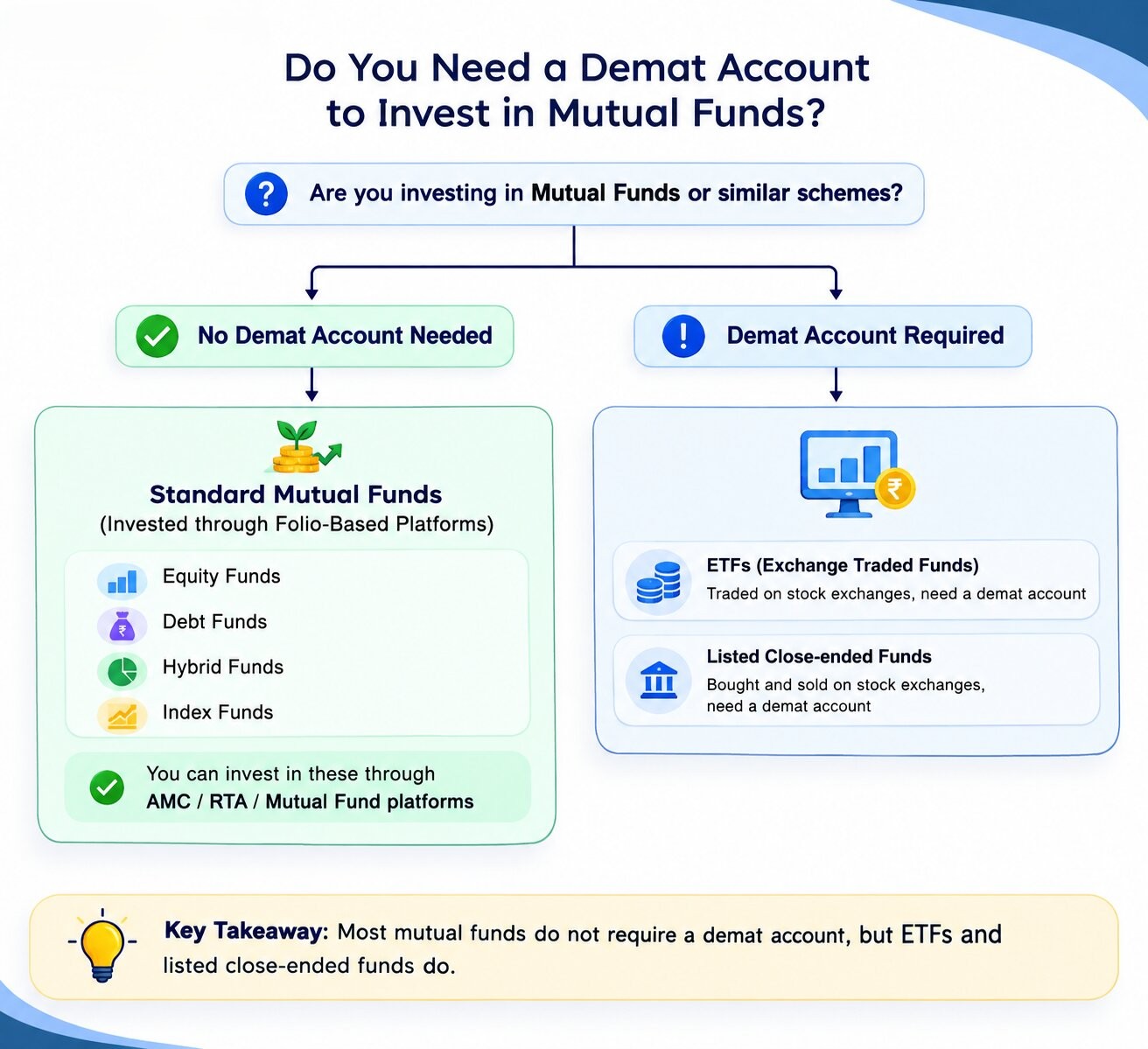
Image Source: AI
How to start investing in mutual funds — without a demat account
If you are starting fresh and want to invest in mutual funds the simplest, cheapest way — here is the exact path. For a step-by-step guide on the full process, see our article on how to start a SIP investment.
- Step 1 — Complete KYC once: Go to MF Central (mfcentral.com). Complete eKYC with your PAN, Aadhaar, and a live selfie. This takes 10–15 minutes and is free. Once done, it applies to every mutual fund investment you will ever make.
- Step 2 — Choose a platform: For direct plans (lower expense ratio), use MF Central, CAMS Online, or KFintech. For a simpler interface, Kuvera or Paytm Money offer direct plans without demat. Avoid platforms that default to regular plans.
- Step 3 — Pick a fund: Choose based on your goal and risk tolerance. For guidance on evaluating a fund before investing, see our guide on how to analyse a mutual fund.
- Step 4 — Invest: Lump sum or SIP. You will receive a folio number — this is your proof of ownership. Save it.
- Step 5 — Track via CAS: Request a Consolidated Account Statement from AMFI — it shows all your mutual fund holdings across all AMCs and folios in one document. Updated monthly.
Questions people ask about demat accounts and mutual funds
Can I invest in SIP without a demat account?
Yes — completely. A SIP is just a regular standing instruction to invest a fixed amount every month in a mutual fund. It has nothing to do with a demat account. Your units are held in folio form and the auto-debit is handled via a NACH mandate linked to your bank account. You set this up through any folio-based platform — AMC website, MF Central, Groww, Kuvera — without ever touching a demat account.
I already have a demat account from stock investing. Should I use it for mutual funds too?
You can — but check for charges first. Some brokers charge a transaction fee per mutual fund purchase through their demat platform. If your broker’s platform supports direct plans and charges no additional transaction fee, using it for mutual funds alongside your stock portfolio is fine. If it defaults to regular plans or charges per transaction, you are better off using a separate folio-based platform like MF Central for your mutual fund investments.
Is it safe to hold mutual fund units in a folio without a demat account?
Yes — SEBI regulates both routes. Your folio-based mutual fund units are maintained by SEBI-registered RTAs (CAMS and KFintech) and the AMC itself. They are not held by any broker who could default or shut down. You can always access, redeem, or switch your units directly through the AMC or MF Central regardless of which app you originally used to invest.
What is MF Central and is it safe?
MF Central (mfcentral.com) is a SEBI-approved joint platform created by CAMS and KFintech — the two RTAs that together maintain records for virtually all mutual funds in India. It is not a broker or a distributor. It is the official infrastructure layer that allows you to view and manage all your mutual fund folios across all AMCs from one login. It is free to use and requires no demat account.
Do I need a demat account for ELSS mutual funds?
No. ELSS (Equity Linked Savings Scheme) funds qualify for Section 80C deduction and have a 3-year lock-in — but they are standard open-ended mutual funds held in folio form. No demat account is needed. You invest through any folio-based platform exactly as you would with any other mutual fund. For more on ELSS as a tax-saving option, see our comparison of ELSS vs PPF vs FD.
Disclaimer: This article is for educational and informational purposes only. All KYC requirements, folio mechanics, and SEBI regulations cited are verified as of August 4, 2026. Platform features and charges may change — verify with your chosen platform before investing. NiveshKarlo does not endorse any specific mutual fund platform, AMC, or investment approach. Please read all scheme-related documents carefully before investing.

Hello there, my name is Phulutu, and I am the Head Content Developer at Nivesh Karlo. I have 13 years of experience working in fintech companies. I have worked as a freelance writer. I love writing about personal finance, investments, mutual funds, and stocks. All the articles I write are based on thorough research and analysis. However, it is highly recommended to note that neither Nivesh Karlo nor I recommend any investment without proper research, and to read all the documents carefully.