
Direct vs Regular Mutual Funds: Why Direct Plans Win Every Time

Same fund. Same fund manager. Same portfolio. But one plan silently takes 0.5–1% more from your returns every single year. Over 20 years, that gap does not feel small anymore.
This question — listed as FAQ #2 on the r/IndiaInvestments community wiki — gets asked constantly because the answer feels too simple to be true. Direct plans and regular plans of the same mutual fund invest in exactly the same stocks and bonds, are managed by the same fund manager, and follow the same investment strategy. The only difference is cost. And that cost difference, compounded over years, is where a meaningful portion of many Indian investors’ returns quietly disappears.
This article explains what that difference actually is in rupees, why it exists, what changed with SEBI’s April 2026 expense ratio rules, and — importantly — the one situation where a regular plan genuinely makes sense rather than being just inertia.
The only difference between direct and regular plans
When SEBI mandated the creation of direct plans in January 2013, every mutual fund scheme in India was required to offer two variants: a regular plan (the original, bought through distributors) and a direct plan (bought directly from the AMC, without a distributor). Both variants invest identically — same portfolio, same fund manager, same benchmark, same risk profile.
The only difference is the Total Expense Ratio (TER) — the annual charge deducted from the fund’s assets to cover management and operating costs. In a regular plan, the TER is higher because it includes a trail commission paid to the distributor who brought in the investor. In a direct plan, no distributor is involved, so no commission is paid, and the TER is correspondingly lower.
This lower TER means the direct plan’s NAV grows faster than the regular plan’s NAV — every single day, because expenses are accrued daily. Over months and years, the two NAVs diverge, and the corpus in the direct plan becomes larger than in the regular plan, even though both invested in exactly the same underlying securities.
What the expense ratio gap actually costs — in rupees
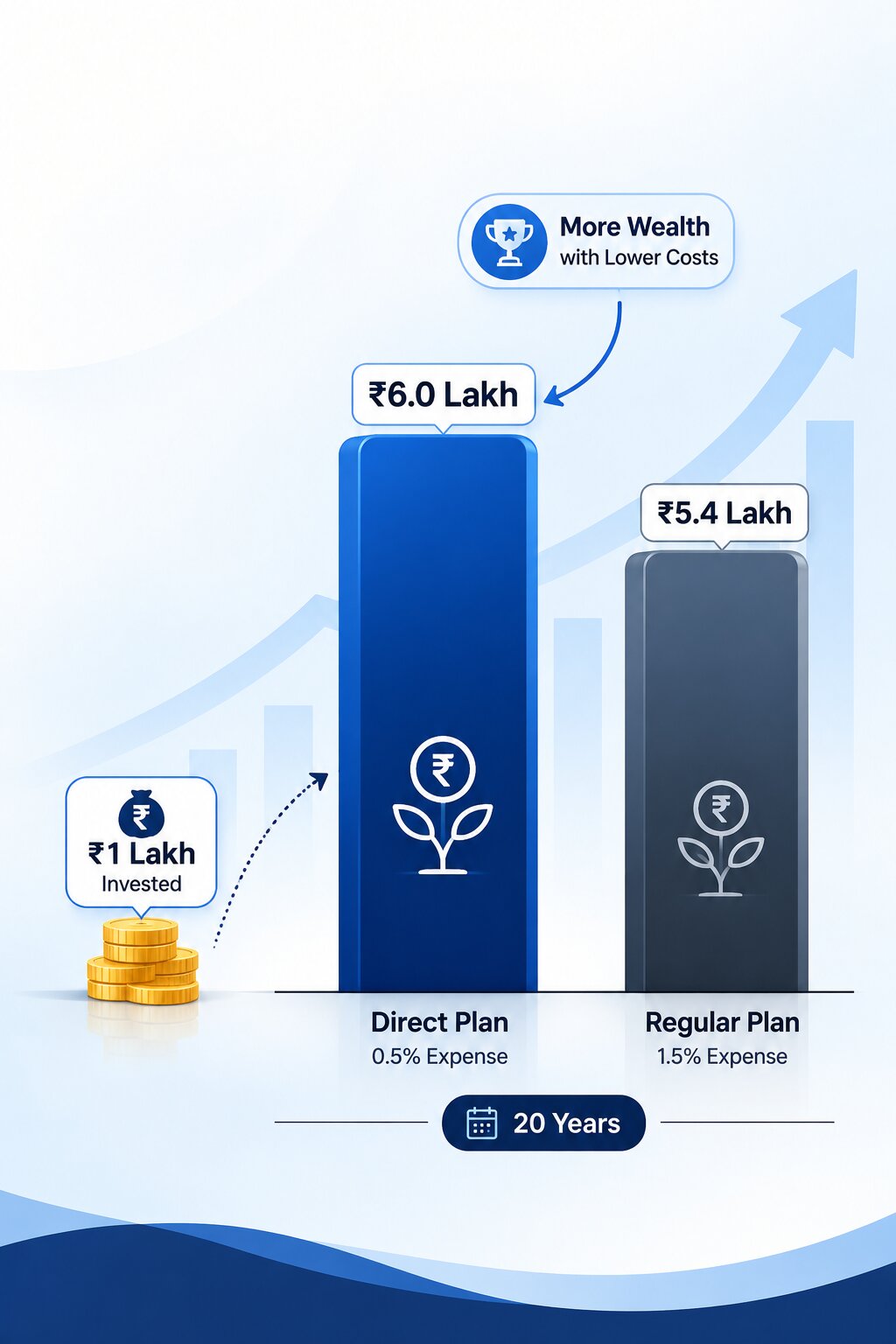
SEBI’s investor education portal illustrates this with a direct example: invest ₹1,00,000 in a fund offering 10% annual returns. In a regular plan with a 1.5% expense ratio, effective return is 8.5%. In a direct plan with a 0.5% expense ratio, effective return is 9.5%. Over 10 years, that 1% annual gap compounds into a significantly different corpus.
| ₹1,00,000 invested for 20 years at 10% gross returns: Regular plan (1.5% expense ratio, 8.5% net return): ~₹4,92,000 Direct plan (0.5% expense ratio, 9.5% net return): ~₹6,14,000 Difference: ~₹1,22,000 — on an original investment of ₹1,00,000. The expense ratio gap does not just reduce your returns. It reduces the corpus on which all future returns are calculated. This is the tyranny of compounding costs — a phrase made famous by Vanguard founder Jack Bogle, and cited directly by the r/IndiaInvestments wiki. All figures illustrative. Actual returns are market-linked and not guaranteed. |
For a SIP investor putting in ₹10,000 per month over 20 years, the rupee impact is proportionally larger — the gap between direct and regular plan corpus at typical expense ratio differences can run into several lakh rupees. Our guide on the power of SIP over time shows what the same SIP produces at different return rates — the difference between 9.5% and 8.5% compounded over 20 years illustrates exactly this gap.
What the actual expense ratio gap looks like across fund categories
The gap between direct and regular plan TERs varies by fund category. Zerodha Varsity’s analysis shows a typical example: direct plan TER of 1.28% versus regular plan TER of 1.78% — a 0.5% difference. This 0.5% gap is entirely the distributor’s trail commission, embedded in the regular plan’s TER.
| Fund category | Direct plan TER (typical) | Regular plan TER (typical) | Approximate gap |
| Active equity (large-cap) | 0.5–1.0% | 1.0–1.5% | ~0.5–1.0% |
| Active equity (mid/small-cap) | 0.8–1.5% | 1.3–2.0% | ~0.5–1.0% |
| Index fund (Nifty 50) | 0.05–0.20% | 0.3–0.6% | ~0.2–0.5% |
| Debt fund (liquid/overnight) | 0.10–0.20% | 0.25–0.40% | ~0.1–0.2% |
For index funds, the gap is smaller in absolute percentage terms but still meaningful — a direct plan Nifty 50 index fund from a large AMC can charge as little as 0.05-0.10%, while its regular plan counterpart charges 0.3-0.6%. Since index funds already work on the premise of minimising costs, paying a regular plan expense ratio on an index fund is particularly counterproductive.
What changed from April 2026 — and why the gap hasn’t closed
From April 1, 2026, SEBI introduced a structural change requiring AMCs to disclose the TER as three separate components: the Base Expense Ratio (BER), brokerage and transaction costs, and statutory charges. This unbundling was designed to make the cost structure of each plan more transparent to investors — so the commission embedded in a regular plan is now explicitly visible rather than bundled into a single TER number.
What this change does not do is close the gap between direct and regular plans. The commission is now more visible, but it is still there. For active equity direct plans, the BER post-April 2026 is estimated at 1.5–1.8% for large AMCs. Index fund direct plans from large AMCs can now operate at under 0.10% — a level that makes the regular plan alternative even less defensible for cost-conscious investors.
The transparency change also means investors can now see exactly how much of their regular plan expense goes to the distributor versus the fund management fee. This is useful information for anyone evaluating whether the distributor’s advisory services justify the ongoing trail commission cost.
The one case where a regular plan genuinely makes sense
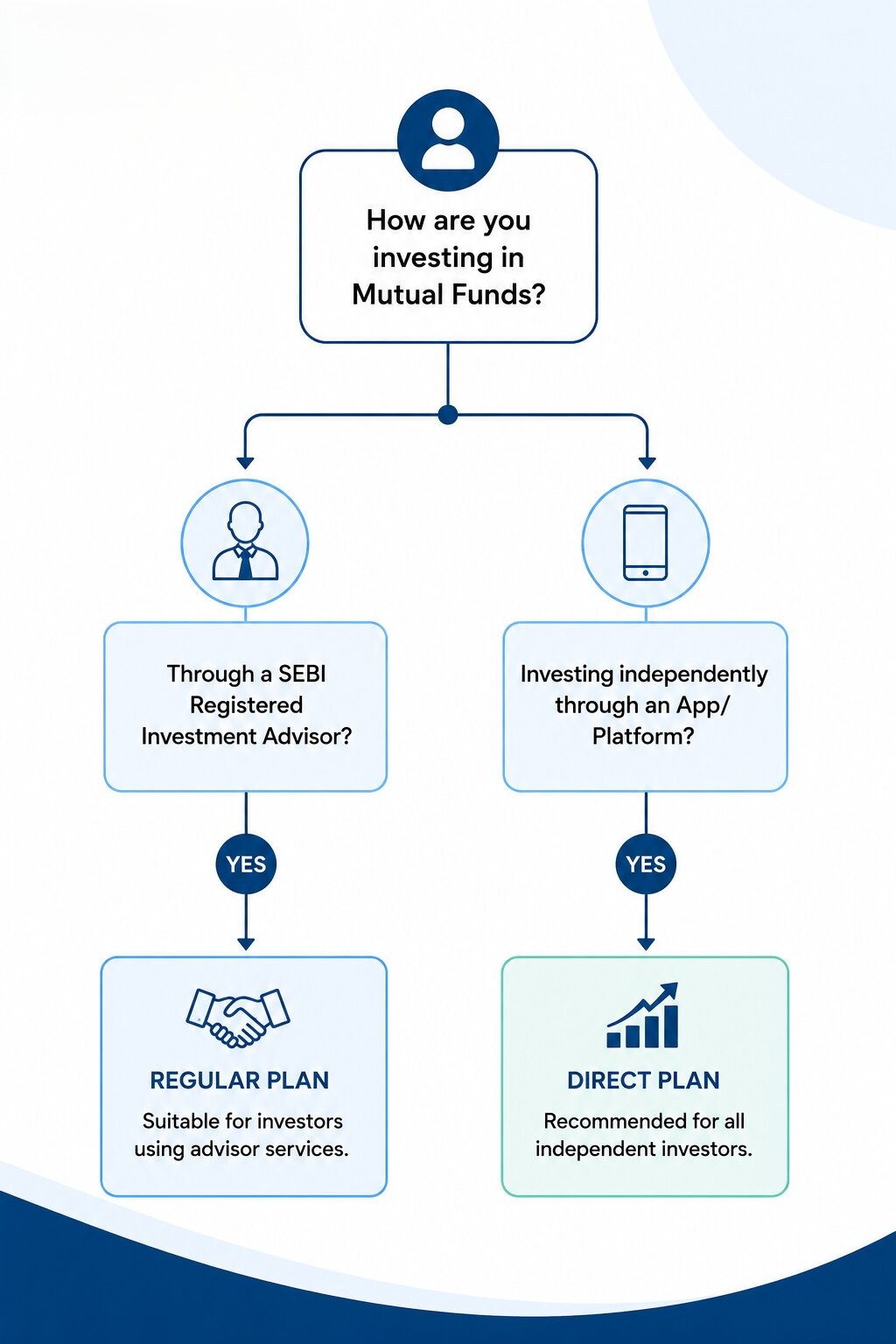
The r/IndiaInvestments wiki is direct about this: regular plans add no value to the portfolio of an investor who is capable of making their own fund selection decisions. But there is one legitimate exception — an investor who genuinely cannot make fund selection decisions independently and is using a SEBI-registered investment advisor (RIA) for fee-based advice.
The distinction matters. A SEBI-registered RIA charges a fee for advice and is legally prohibited from earning commissions — they are required to put clients in direct plans. A mutual fund distributor (MFD), on the other hand, earns trail commission from the AMC through the regular plan. The services they offer may be valuable to some investors, but the cost structure means they are inherently incentivised toward funds with higher commission rates, not necessarily the best funds for the investor.
For an investor who specifically wants professional portfolio management and is working with an RIA who charges a transparent fee: direct plan plus fee is almost always cheaper than regular plan plus zero advisory fee. The commission embedded in regular plans typically costs more than a reasonable advisory fee.
For everyone else — anyone investing through an app, a mutual fund platform, or directly on an AMC website — there is no justification for a regular plan. Platforms like MF Central and Zerodha Coin offer direct plans free of charge, with the same KYC process and the same ease of use as regular plan platforms.
How to check whether you are in a direct or regular plan right now
Many investors who set up SIPs through bank branches, insurance agents, or financial advisors in the past are in regular plans without realising it. Here is how to check:
- Look at your mutual fund statement: Your CAMS or KFintech statement shows the plan name for each holding. A regular plan will explicitly say ‘Regular’ or ‘Reg’ in the scheme name. A direct plan will say ‘Direct’ or ‘Dir’.
- Log in to the AMC’s app or website: Your portfolio page shows the full scheme name including whether it is direct or regular. If the app you used to invest routes through an advisor or bank, it is likely a regular plan.
- Check the expense ratio: On the fund’s factsheet or the AMC website, compare the TER of the direct plan versus the regular plan for the same fund. If your current TER matches the regular plan, you are in the regular plan.
For a guide on how to analyse a mutual fund including where to find the expense ratio on a factsheet, see our dedicated article. If you find you are in regular plans and want to switch to direct plans, the switch involves a redemption of regular plan units and reinvestment into direct plan units — which is a taxable event. The tax implications should be factored into the switching decision, particularly for older investments with significant gains.
Also Read: Which Date Is Best for SIP? The Honest Answer | SIP vs Lump Sum: How Smart Investors Are Growing Wealth Faster!
Questions people ask about direct vs regular plans
Are the returns from a direct plan always higher than a regular plan?
Yes — for the same fund, the direct plan’s net returns are always higher than the regular plan’s because the only difference between the two is the expense ratio. Both invest identically. The direct plan’s lower TER means more of the fund’s gross return reaches the investor. The difference compounds over time — it is small in year 1 and significant by year 20.
Is switching from regular to direct plan a good idea?
Switching is almost always worth it for long-term investments — the annual saving from the lower TER compounds significantly over time. However, switching from a regular to a direct plan of the same fund is treated as a redemption and reinvestment, which triggers capital gains tax. For investments with large gains, the immediate tax cost needs to be weighed against the long-term TER saving. For investments held less than 1 year in equity funds, the STCG tax (20%) makes immediate switching expensive. For long-held investments where LTCG applies, the calculation is often still favourable for switching.
Can I invest in direct plans without a financial advisor?
Yes — and this is the whole point of direct plans. They are designed for investors who make their own fund selection decisions. You can invest in direct plans through AMC websites and apps, MF Central (mfcentral.com), Zerodha Coin, Groww (in direct mode), Paytm Money, and several other SEBI-registered platforms. The process is identical to investing in a regular plan — KYC, fund selection, and SIP setup — with the only difference being the plan selected.
Does the direct plan have a higher NAV — is that a disadvantage?
No — this is a common misconception. A higher NAV in the direct plan simply means the plan has grown more over time due to lower cost drag. It does not mean the direct plan is more expensive to buy into. When you invest ₹5,000 in a fund with NAV ₹100, you get 50 units. When you invest ₹5,000 in the same fund’s direct plan with NAV ₹110, you get 45.5 units. The total value invested is identical — the units are just priced differently because the direct plan has compounded more. See our guide on what NAV means in mutual funds for a full explanation.
What is the difference between a distributor and a SEBI-registered RIA?
A mutual fund distributor (MFD) earns trail commission from the AMC through regular plan investments. They are required to disclose this commission but are not legally bound to act in the investor’s best interest. A SEBI-registered investment advisor (RIA) charges a transparent fee to the investor, cannot earn commissions, and is legally required to act as a fiduciary. RIAs put clients in direct plans and charge a separate advisory fee. For most investors using a self-directed app or platform, neither a distributor nor an RIA is involved — and direct plans are the appropriate choice.

Hello there, my name is Phulutu, and I am the Head Content Developer at Nivesh Karlo. I have 13 years of experience working in fintech companies. I have worked as a freelance writer. I love writing about personal finance, investments, mutual funds, and stocks. All the articles I write are based on thorough research and analysis. However, it is highly recommended to note that neither Nivesh Karlo nor I recommend any investment without proper research, and to read all the documents carefully.