How to Switch from Regular to Direct Mutual Fund: Step-by-Step

Most people who switch end up paying capital gains tax they didn’t need to. There’s a cleaner way — and if the switch does make sense, here is exactly how to do it.
You’ve heard it a hundred times: switch to direct plans, save on expense ratio, earn more over the long run. All of that is true. What most articles don’t tell you upfront is that switching existing units from regular to direct triggers a capital gains tax event — and for a lot of investors, the tax cost makes the move less worthwhile than just starting fresh in direct from here.
The IndiaInvestments community wiki has a smarter approach that most people miss. This article covers that first, then walks through the actual switching process for cases where it does make sense.
The move most people miss: stop the SIP, start fresh, leave old units alone
Before you switch anything, consider this approach — it’s what experienced investors on the community forums recommend, and it avoids the tax hit entirely.
| The cleaner approach: 1. Stop your SIP in the regular plan. (No cost — cancelling a SIP is free.) 2. Start a new SIP in the direct plan of the same fund. Same scheme, lower expense ratio, all new contributions going into the cheaper option. 3. Leave the regular plan units where they are. Don’t touch them. Let them keep growing. Redeem them when you actually need the money ideally after crossing the 12-month mark so LTCG rates apply. What you get: All new money earns at the direct plan’s lower expense ratio. No tax triggered. No exit load. No paperwork. Over 2–3 years, the regular plan units become a smaller part of your portfolio as the direct plan grows and you redeem the regular plan units gradually, at a time that makes tax sense. |
This isn’t a compromise. For anyone whose regular plan units have significant gains — or who bought them recently and would face the 20% STCG rate — leaving them and redirecting new money into direct is the better financial decision. The expense ratio saving on direct plans is real and meaningful over time. But triggering a large tax bill to get there faster doesn’t always add up.
When switching existing units does make sense — the maths
Switching makes sense when the one-time tax cost is small relative to the ongoing saving. Here are the tax rates that apply:
| Fund type | Holding period | Tax on gains when you switch |
| Equity / equity mutual fund | Under 12 months | 20% flat — Short Term Capital Gains (STCG) |
| Equity / equity mutual fund | Over 12 months | 12.5% on gains above ₹1.25 lakh/year — Long Term Capital Gains (LTCG) |
| Debt mutual fund (bought after April 1, 2023) | Any period | Taxed at your income slab rate — no special rate |
| ELSS fund | Within 3-year lock-in | Cannot switch at all — units are locked per instalment |
Also check the exit load. Most equity funds charge 1% if you redeem within 12 months of purchase. If your regular plan units were bought recently, add that to the cost of switching. On top of tax, a 1% exit load on a ₹5 lakh portfolio is ₹5,000 out of pocket before you’ve saved a rupee.
| The maths that makes switching worthwhile: Expense ratio gap (regular vs direct): typically 0.5–1% per year On a ₹5 lakh corpus: saving of ₹2,500–5,000/year If LTCG tax on the switch = ₹3,000 → payback in under 2 years ✅ If STCG tax on the switch = ₹15,000 → payback takes 3–6 years ⚠ The switch is cleanest when your LTCG is under ₹1.25 lakh that amount is exempt from tax each financial year. A switch within that limit costs you nothing. |
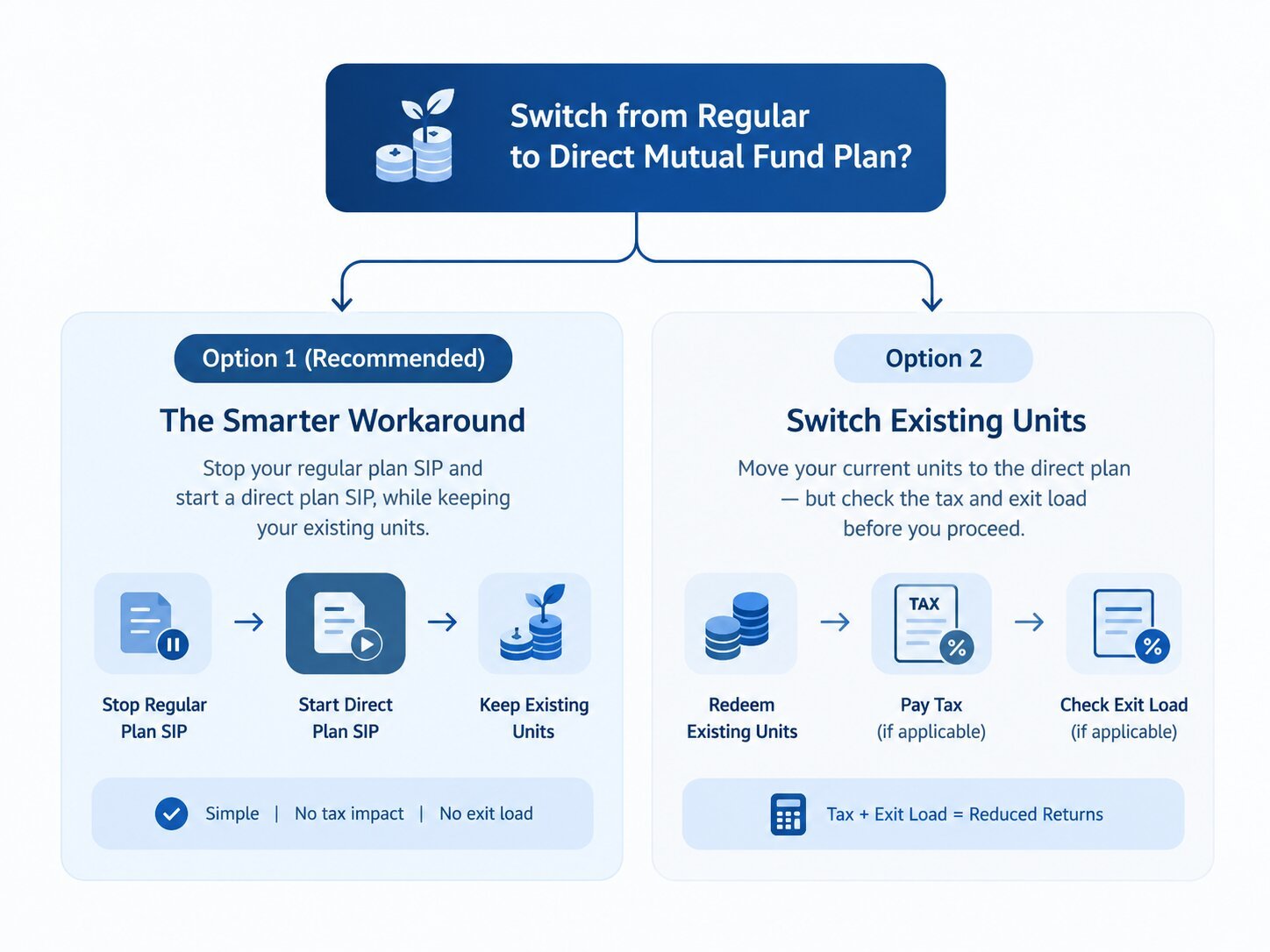
Image Source: AI
How to switch — the actual steps
If the maths works in your favour, here are the three ways to do it.
Method 1: MF Central — works for all funds, all AMCs
MF Central (mfcentral.com) is the SEBI-approved joint platform built by CAMS and KFintech. One login gives you a consolidated view of every mutual fund you hold across all AMCs — and you can switch from there without going to each AMC separately.
- Go to mfcentral.com. Log in with your PAN and the mobile number registered with your mutual funds.
- Select ‘Transactions’ from the dashboard.
- Choose ‘Switch’ as the transaction type.
- Pick the folio and the regular plan fund you want to move out of.
- Select the target: the direct plan of the same scheme.
- Enter the amount or number of units. You can switch partially — you don’t need to move everything at once.
- Confirm the details and submit with OTP.
- Done. Processing takes 1–3 working days. Confirmation comes to your registered email.
| MF Central is the cleanest option if you have funds across multiple AMCs. One login, one screen, no need to repeat the process on each AMC’s app. |
Method 2: AMC website or app
Works well if your funds are with one or two AMCs and you’re comfortable using their apps (HDFC MF, SBI MF, Mirae, Axis, etc.).
- Log in to the AMC’s app or website.
- Go to ‘My Investments’ or ‘Transactions’.
- Find the regular plan fund. Select ‘Switch’.
- Choose the direct plan of the same scheme as the target.
- Enter the amount or units, verify, submit.
One thing to check: some AMC platforms don’t allow switching to direct plans if you originally invested through a distributor. If that happens, use MF Central instead — it bypasses this restriction.
Method 3: Offline switch form
Download the Switch Form from AMFI’s website or the AMC’s branch. Fill in your folio number, the scheme name you’re switching from, the direct plan scheme name you’re switching to, and the amount or units. Sign and submit at the nearest AMC branch or Investor Service Centre.
| Use the offline form when: online switch fails, your KYC is outdated, or the AMC’s portal won’t process the request. Timeline: 3–5 working days. For KYC update before switching, visit mfcentral.com or any KRA office. |
Four things to check after the switch goes through
- Confirmation email: Save it. It shows the NAV at which your regular plan units were redeemed and the NAV at which the direct plan units were allocated. You’ll need this for capital gains calculation.
- New folio number: Most AMCs create a separate folio for the direct plan units — different from your regular plan folio. Both folios show up on your CAS statement. This is normal, not a mistake.
- Capital gains in your ITR: The switch appears as a redemption in your CAMS or KFintech capital gains statement at year-end. Report it in your ITR for the financial year the switch happened. See our step-by-step guide on how to show capital gains in ITR-2 for the exact process.
- Your SIP is still running in the regular plan: Switching units doesn’t cancel your SIP. You have to stop the regular plan SIP separately through the AMC app, MF Central, or your broker — and then set up a new SIP in the direct plan. See our guide on how to stop a SIP. The new direct plan SIP takes 20–30 days to activate (new NACH mandate required).
Questions people ask when switching
Can I switch without paying any tax?
Yes — if your gains are within the ₹1.25 lakh annual LTCG exemption. Every financial year, the first ₹1.25 lakh of long-term capital gains from equity funds is tax-free. If your gain on the regular plan units is under this limit, switching costs you nothing in tax. You can also spread the switch across two financial years to stay within the exemption each year. For units held under 12 months, the 20% STCG rate applies with no exemption — in that case, the workaround (leaving units in place, redirecting new SIP to direct) is usually the better call.
My ELSS is in a regular plan. Can I switch it?
Not while the lock-in is active. Each ELSS instalment has its own 3-year lock-in from the date of purchase — a January 2024 instalment unlocks in January 2027. Switching, redeeming, or transferring ELSS units before the 3-year period is not possible. Once unlocked, you can switch to the direct ELSS plan of the same fund, subject to LTCG on any gains. For more on ELSS, see our comparison of ELSS vs PPF vs FD.
Does switching reset my holding period?
Yes. From a tax perspective, the direct plan units you receive are treated as a fresh purchase made on the date of the switch. Your holding period for the new direct plan units starts from zero. The regular plan units you exited are treated as redeemed on that date — the holding period and gains from those units are calculated and taxed. Going forward, the clock for the direct plan units starts fresh.
Can I switch only some units, not all?
Yes. You can switch partially — enter a specific number of units or a rupee amount. This is useful if you want to switch in tranches across multiple financial years to stay within the annual LTCG exemption each time. MF Central and most AMC platforms support partial switches without any restriction.
I invested through my bank. Can I switch to direct on MF Central?
Yes — SEBI rules allow this regardless of how you originally invested. MF Central gives you access to all your folios, including those created through bank branches or distributors. If your KYC is current, the switch goes through normally. If the online process fails (sometimes KYC linked to old mobile numbers causes issues), the offline switch form submitted at any AMC branch resolves it.
Will my returns go up immediately after switching?
The lower expense ratio on the direct plan takes effect from day one — but the compounding impact builds over months and years, not overnight. The direct plan’s NAV grows slightly faster than the regular plan’s every single day because expenses are accrued daily at a lower rate. Over 5–10 years, this adds up to a meaningful difference in corpus. For the full numbers on what the expense ratio gap costs over time, see our guide on direct vs regular mutual funds.

Hello there, my name is Phulutu, and I am the Head Content Developer at Nivesh Karlo. I have 13 years of experience working in fintech companies. I have worked as a freelance writer. I love writing about personal finance, investments, mutual funds, and stocks. All the articles I write are based on thorough research and analysis. However, it is highly recommended to note that neither Nivesh Karlo nor I recommend any investment without proper research, and to read all the documents carefully.