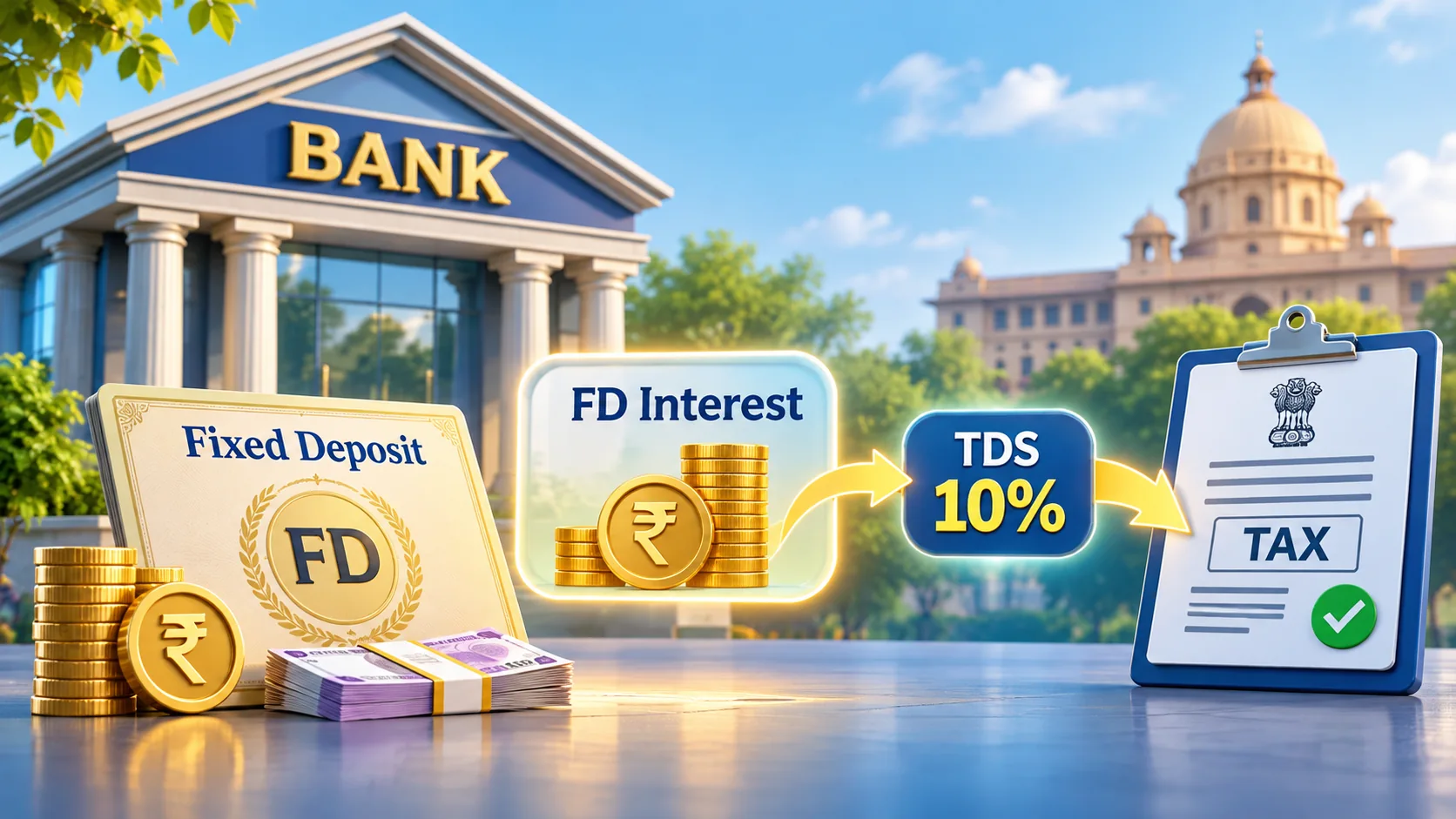
Why Does the Bank Cut TDS on Your FD and Can You Prevent It?

Many FD investors notice a deduction on their interest credit and assume the bank made an error. It didn’t. Banks are legally required to cut TDS on FD interest once it crosses a threshold — and the money is gone from your hands until you file your ITR and claim it back. The short answer to whether you can prevent it: yes, if you qualify. This article explains why the deduction happens, exactly when it applies, and the steps that stop it before the bank acts.
Why Banks Are Required to Cut TDS in the First Place
FD interest is classified as Income from Other Sources under the Income Tax Act, 2025 — which means it gets added to your total income and taxed at your slab rate. Unlike equity mutual fund gains, which are only taxed when you redeem, FD interest accrues and becomes taxable every financial year, even if your FD hasn’t matured yet.
This catches many investors off guard at maturity. They receive a lump sum, assume it’s all current-year income, and then find out they should have been declaring a portion each year.
Because FD interest is regular income at your slab rate, the government requires banks to collect tax at source rather than wait for you to pay it at year-end. That is TDS — Tax Deducted at Source. The bank acts as a collection agent for the Income Tax Department, cutting a portion before the money reaches you.
When Exactly Does the Bank Deduct TDS and How Much
Banks are legally required to deduct TDS before crediting FD interest. From April 1, 2026, this falls under Section 393 of the Income Tax Act, 2025 (previously Section 194A). The rates and logic remain the same:
- 10% TDS if your PAN is registered with the bank
- 20% TDS if your PAN is not registered
TDS is deducted only when your total FD interest from that bank crosses the threshold in a financial year. The thresholds as of FY 2026-27 are:
| Investor type | TDS kicks in when annual interest exceeds | TDS rate (with PAN) |
| Individuals below 60 | ₹50,000 | 10% |
| Senior citizens (60+) | ₹1,00,000 | 10% |
One point that trips people up: the threshold is per bank, not across all your FDs in India. If you have ₹60,000 interest from SBI and ₹60,000 from HDFC, neither bank deducts TDS. Your total interest of ₹1.2L is still taxable income and must be declared in your ITR — but you receive it without TDS.
Interest on savings accounts, by contrast, does not attract TDS regardless of the amount.
What Changed in April 2026: Form 121 Replaces Form 15G and 15H
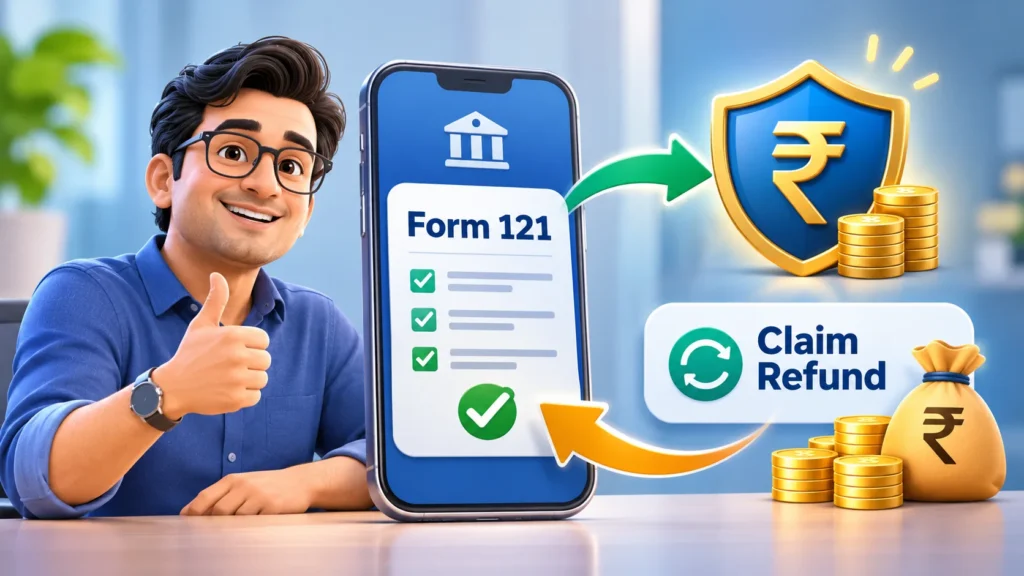
From April 1, 2026, Forms 15G and 15H no longer exist. They have been replaced by a single unified declaration called Form 121, introduced under the Income Tax Act, 2025. If you submitted 15G or 15H last year, you now submit Form 121 — the purpose is identical but the form is consolidated.
Form 121 tells the bank: “My estimated total income for the year is below the taxable limit — please do not deduct TDS.” The bank is then legally bound to skip TDS on your interest for that financial year. You can read the official Income Tax portal for the latest version of the form.
Who Can Submit Form 121
- Resident individuals under 60 years, if estimated tax liability for the year is nil and specified income does not exceed the basic exemption limit
- Senior citizens (60+), if estimated tax liability is nil — even if total income is higher, as long as deductions bring tax liability to zero
- Hindu Undivided Families (HUFs) meeting the same income criteria
Who cannot submit Form 121:
- Non-resident Indians (NRIs)
- Companies and firms
- Anyone with a tax liability above zero after all deductions
How to Submit Form 121 Practically
- Submit it at the start of the financial year — April is ideal, before any interest is credited
- Submit a separate form to each bank where you hold FDs
- Most major banks now accept Form 121 through their net banking or mobile app — no branch visit needed
- The form is valid for one financial year only. You must submit again each April
- Keep a copy with your tax documents
If you miss submitting and TDS gets deducted, you don’t lose that money. You claim it back as a refund when you file your ITR. The refund typically arrives within a few months if your ITR is filed before the deadline.
Does Everyone Have to Pay Tax on FD Interest? The New Tax Regime Changes the Answer
Under the new tax regime for FY 2026-27, total income up to ₹12 lakh attracts zero tax after rebate under Section 87A. This means if your total income — salary, FD interest, and everything else — stays under ₹12 lakh, you have zero tax liability and are eligible to submit Form 121.
For salaried individuals with income above ₹12 lakh, FD interest gets stacked on top of salary and taxed at the marginal rate. Someone earning ₹18 lakh in salary who also earns ₹1.5 lakh in FD interest pays 30% on that ₹1.5 lakh (assuming the new regime).
Senior citizens get a specific advantage under Section 80TTB of the old tax regime: a deduction of up to ₹50,000 on interest income from banks, post offices, and co-operative societies. This deduction is not available under the new tax regime. Senior citizens choosing the old regime should factor this in before switching. For more on the tax regime comparison, the Income Tax Department has a regime comparison calculator.
So Can You Prevent TDS? Yes — Here Are the Ways That Actually Work
1. Spread FDs Across Banks
Since the TDS threshold applies per bank, spreading deposits across two or three banks keeps each bank’s annual interest payout below ₹50,000. No TDS gets deducted — though the interest remains fully taxable and must be declared in your ITR.
This is a TDS management strategy, not a tax reduction strategy. Your total tax liability stays the same. What you avoid is the hassle of claiming a refund.
2. Invest in a Spouse’s or Parent’s Name
If your spouse has little or no income, FDs booked in their name are taxed at their (lower) slab rate. A retired parent with income below ₹7 lakh pays zero tax on FD interest under the new regime after rebate. This is a legitimate and commonly used method — but the funds must genuinely be gifted, not a sham transfer. Clubbing provisions under Section 64 can override this if the gift is to a minor child or a non-working spouse for income-generating assets.
3. Time Your FDs to Manage Annual Accrual
A 2-year FD booked on April 1 accrues interest roughly equally across both financial years. A 2-year FD booked on March 31 pushes the bulk of the second year’s accrual into the following year. If you’re expecting a salary increment or bonus in one year, booking FDs to shift interest accrual into the lower-income year reduces overall tax outgo.
4. Consider Debt Mutual Funds for Large Amounts
For amounts above ₹5 lakh, short-duration or low-duration debt funds let you control when gains are realised. You can redeem in a year where your income is lower. FDs don’t give you this flexibility — interest accrues annually whether you want it to or not. The tradeoff is that debt funds carry market risk and don’t have a guaranteed return.
5. Use a Post Office Time Deposit for the Senior Citizen TDS Benefit
Senior citizens earn up to ₹1 lakh annually from a single bank before TDS kicks in. Post office time deposits fall under the same Section 393 rules — the ₹1 lakh threshold applies there too. A senior citizen spreading FDs across one bank and one post office can earn up to ₹2 lakh annually without any TDS deduction. The interest remains taxable but TDS management becomes simpler.
6. Tax-Saving FD Under Section 80C
A 5-year tax-saving fixed deposit qualifies for a deduction of up to ₹1.5 lakh under Section 80C — the same section that covers PPF, ELSS, and life insurance premiums. The principal invested reduces your taxable income. The interest earned, though, is fully taxable at your slab rate every year. This deduction is available only under the old tax regime and not under the new one.
Tax-saving FDs have a mandatory 5-year lock-in with no premature withdrawal. If reducing your taxable income under 80C is the goal, ELSS funds offer the same deduction with a shorter 3-year lock-in, though with market-linked returns rather than a guaranteed rate.
One More Thing: Section 80TTA and Savings Account Interest
Under the old tax regime, individuals and HUFs under 60 can claim a deduction of up to ₹10,000 on savings account interest under Section 80TTA. This covers interest from bank savings accounts, post office savings accounts, and co-operative banks. FD interest does not qualify — 80TTA applies to savings accounts only.
Senior citizens get the more generous Section 80TTB instead (up to ₹50,000 on interest from banks, post offices, and co-operatives, covering both savings and deposit accounts). Both deductions are available only under the old regime.
TDS Was Not Deducted — Does That Mean You Owe Nothing?
No. TDS not being deducted does not mean the income is not taxable. This is the single most common mistake with FD interest management.
Every bank reports interest credited or accrued to the Annual Information Statement (AIS) on the Income Tax portal. If you declare less FD interest in your ITR than what the AIS shows, the system flags a mismatch and may issue a notice. Even if no TDS was deducted, the interest must be declared under “Income from Other Sources.”
To verify what your banks have reported, log into the Income Tax portal and check your AIS before filing. The interest shown there, not the amount you received in hand, is the figure that must appear in your ITR.
FD TDS Rules at a Glance
| Question | Answer |
| Is FD interest taxable? | Yes, at your income slab rate every year |
| TDS threshold (under 60) | ₹50,000 per bank per year |
| TDS threshold (60+) | ₹1,00,000 per bank per year |
| TDS rate with PAN | 10% |
| TDS rate without PAN | 20% |
| Form to avoid TDS (from April 2026) | Form 121 (replaced Form 15G and 15H) |
| Form 121 valid for | One financial year — resubmit every April |
| Savings account interest — TDS? | No TDS. Still taxable, must be declared in ITR |
| TDS deducted by mistake — what to do? | Claim refund while filing ITR |
Questions People Ask
If no TDS is deducted, do I still need to pay tax on FD interest?
Yes. TDS is a mechanism for advance collection of tax — it’s not the tax itself. If your FD interest pushes your total income above the taxable limit, you owe tax on it regardless of whether TDS was deducted. Declare it in your ITR and pay the difference if any.
My FD is in a co-operative bank. Does the same TDS rule apply?
Yes, the same thresholds and TDS rate apply to co-operative banks. The Section 393 rules cover all banking institutions, including co-operative banks and post office deposits.
Can I submit Form 121 if I am a salaried employee?
Yes, if your total estimated income for the year — salary plus FD interest plus everything else — results in zero tax liability after all deductions and rebates, you can submit Form 121. Most salaried individuals with income above ₹12 lakh will have a tax liability and cannot use Form 121 to avoid TDS on FD interest.
What happens if I submit Form 121 but my actual income ends up being higher?
You become liable for TDS that should have been deducted, plus interest on the shortfall. If the gap is significant, the tax department can also levy a penalty. It’s important to estimate income conservatively when deciding whether to submit Form 121.
My bank shows less interest in Form 26AS than I actually earned. Which figure do I use?
Use your AIS (Annual Information Statement), not Form 26AS. AIS is more comprehensive. Cross-check with your FD passbook or interest certificates from the bank. If there’s a discrepancy, report the correct accrued interest in your ITR — always err on the side of declaring more, not less.
The Short Answer to the This Question
Yes, you can prevent TDS on your FD — if you qualify. Submit Form 121 every April before interest is credited, spread deposits across banks to stay below the per-bank threshold, and check your AIS before filing your ITR. If TDS was already deducted and you didn’t owe that tax, claim it back when you file — it comes back as a refund. For investors in the 30% bracket with large FD balances, the tax drag is real and short-duration debt funds give more control over when gains are realised, at the cost of market risk and no guaranteed return.

Hello there, my name is Phulutu, and I am the Head Content Developer at Nivesh Karlo. I have 13 years of experience working in fintech companies. I have worked as a freelance writer. I love writing about personal finance, investments, mutual funds, and stocks. All the articles I write are based on thorough research and analysis. However, it is highly recommended to note that neither Nivesh Karlo nor I recommend any investment without proper research, and to read all the documents carefully.