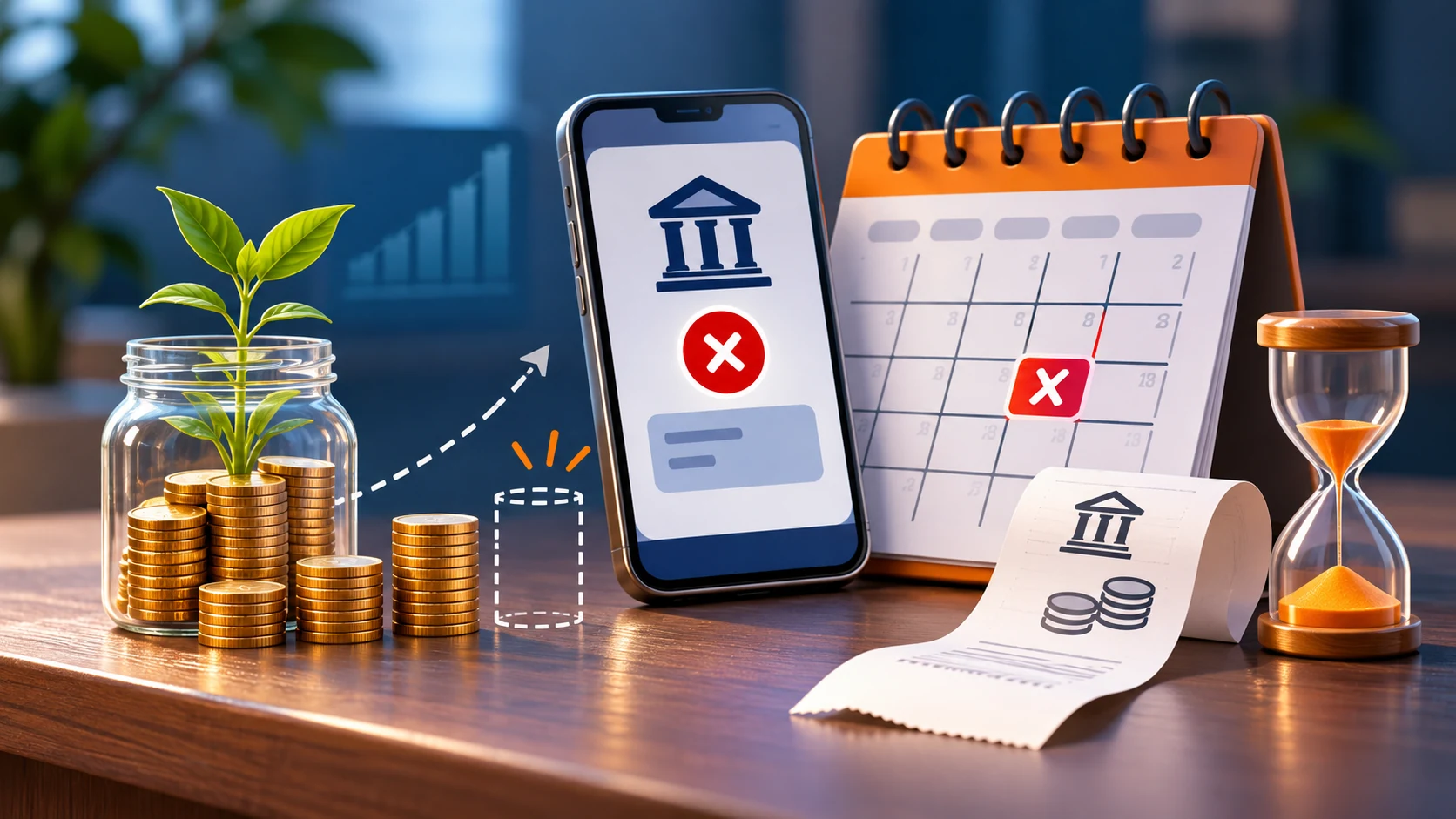
What Happens to Your SIP When You Miss a Payment?

Your SIP debit date comes and goes. The bank account did not have enough balance. Nothing dramatic happens immediately – no call, no letter, no alert from the AMC that anything is wrong.
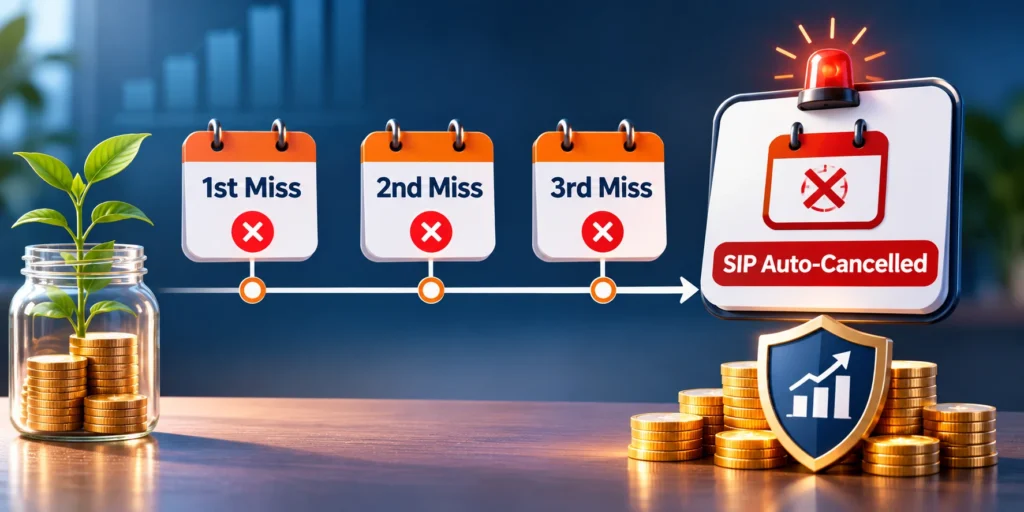
What does happen is quieter and more expensive. Your bank charges a bounce fee the same day. If it happens again the next month, the charge repeats. After three consecutive failures on a monthly SIP, the mandate is auto-cancelled under SEBI’s April 2024 circular – and the AMC notifies you only after the fact. It is the same silent mechanic as paying only the minimum due on a credit card – the damage builds without a warning.
This article covers what actually happens at each stage – the charges, the cancellation rules, the CIBIL score question everyone gets wrong, and how to recover. It also covers one thing most people do not know: a successful payment resets the failure count, so the situation is recoverable.
What Happens the Moment a SIP Payment Fails
When your bank cannot process a SIP debit – because the account balance is insufficient or the mandate has an issue – two things happen simultaneously:
- The SIP installment for that month is skipped. No units are purchased. That month’s investment simply does not happen.
- Your bank raises an ECS or NACH return charge, also called a bounce charge, against your account. This is charged the same day or within one business day.
The AMC is notified of the failed debit by the payment system. Under SEBI’s uniform SIP cancellation circular (effective April 1, 2024), the AMC or registrar must send you a notification – email or SMS – after the first failed installment. In practice, this notification often arrives 2-3 business days after the failure date.
Your existing SIP units are unaffected. The units you already hold remain in your folio. The NAV on those units continues to move with the market. The only loss is the missed installment‘s worth of units – you simply did not buy anything that month.
The Bounce Charges: Bank by Bank
Bounce charges are set by individual banks and vary significantly. The figures below are sourced from AngelOne’s bank-wise bounce charge analysis and are exclusive of 18% GST:
| Bank | Bounce Charge (excl. GST) | With 18% GST |
| SBI | Rs 250 | Rs 295 |
| Punjab National Bank | Rs 250 | Rs 295 |
| Nainital Bank / Indian Overseas Bank | Rs 250 | Rs 295 |
| IndusInd Bank | Rs 350 (1st in quarter), Rs 500 after | Rs 413 / Rs 590 |
| HDFC Bank | Rs 450+ (rises with repeats) | Rs 531+ |
| ICICI Bank | Rs 500 | Rs 590 |
| Kotak Mahindra Bank | Rs 500 | Rs 590 |
| Axis Bank | Rs 500 (1st), Rs 550 (repeat) | Rs 590 / Rs 649 |
| IDFC First Bank | Capped at Rs 750 after 3 failures | Rs 885 |
| Canara Bank | Rs 300 to Rs 2,000 (tiered by SIP size) | Rs 354 to Rs 2,360 |
The practical consequence: a Rs 1,000 monthly SIP that fails once at ICICI or Kotak costs Rs 590 in penalties – more than half the missed installment itself. Five SIPs failing on the same date at ICICI would cost Rs 2,950 in a single day, as Business Today reported in April 2026.
When Does the SIP Get Cancelled Automatically?
Under SEBI’s circular on uniform SIP cancellation (January 2024, effective April 2024), AMCs are required to auto-cancel SIPs after a defined number of consecutive failed instalments. The threshold depends on SIP frequency:
| SIP Frequency | Consecutive Failures Before Auto-Cancellation |
| Daily, weekly, fortnightly, monthly | 3 consecutive failed instalments |
| Bi-monthly, quarterly, half-yearly, yearly | 2 consecutive failed instalments |
The key word is consecutive. One missed payment followed by a successful payment resets the count to zero. You would need to miss three months in a row (for a monthly SIP) before auto-cancellation kicks in.
What does not reset the count: a SIP pause. If you pause your SIP for three months and then resume, the failure count from before the pause carries forward. If you had one failure before pausing, you can afford only two more consecutive failures after resuming before the mandate is cancelled.
After auto-cancellation, the AMC must notify you by email or SMS. The existing units in your folio remain yours and are not affected by the cancellation.
Does a Missed SIP Hurt Your CIBIL Score?
No. A missed SIP payment does not affect your CIBIL score or credit report in any way. If protecting your credit health while still growing wealth is the goal, see how balanced advantage funds manage risk automatically without requiring you to time the market.
SIPs are not credit instruments. There is no loan, no EMI, and no lender involved. The NACH mandate used to debit your bank account for a SIP is not reported to credit bureaus. A failed SIP debit does not appear on your CIBIL report, regardless of how many times it happens.
The confusion comes from EMIs, which do affect your credit score when missed. SIPs and EMIs both use NACH mandates for auto-debit, but only EMIs (being loan repayments) are reported to credit bureaus. SIP failures are invisible to CIBIL, Experian, and Equifax.
The Real Cost: What You Actually Lose
The bounce charge is the visible cost. The invisible cost is the missed compounding.
Consider a Rs 10,000 monthly SIP in a large-cap fund averaging 12% annually. Missing one installment does not just mean you skipped Rs 10,000 that month. Over 20 years, that single Rs 10,000 would have grown to approximately Rs 96,000. Missing three instalments in a row – which triggers auto-cancellation on a monthly SIP – costs roughly Rs 2.9 lakh in future corpus, before any restart costs.
AMFI data reported that 50 lakh SIPs were terminated in October 2026 alone. Many of these would have been auto-cancellations where investors were unaware the mandate had lapsed until they checked months later. The underlying fund units remain safe regardless – see what happens to your mutual fund if the AMC shuts down for a full breakdown of how investor holdings are protected.
What to Do If Your SIP Has Failed
If it was the first miss
Check your bank account balance and ensure the account linked to the SIP mandate has sufficient funds before the next debit date. No action is required with the AMC – the SIP will attempt again next month automatically. Pay the bounce charge your bank has applied.
If it has been cancelled automatically
Log into the AMC’s platform, Groww, Zerodha, MF Central or whichever platform you used to start the SIP. Check the SIP status. If it shows cancelled, you need to register a fresh SIP – the old mandate is dead and cannot be reactivated.
Registering a fresh SIP means a new NACH mandate, which takes 21-30 days to activate at most banks. During this window, your SIP will not run. Plan accordingly so you do not lose another month’s installment during the registration window. While restarting, it is also worth checking whether you are investing through a regular plan – if so, switching to a direct mutual fund before registering the fresh SIP saves you the expense ratio gap every month going forward.
If you want to avoid this in future
- Keep a buffer of at least 2-3 months of SIP amount in the linked account before the debit date
- Set a calendar reminder 2-3 days before each SIP date to verify the balance
- If your income is irregular, consider the SIP pause facility – pausing does not count as a failure and does not affect the failure count
- Enable SMS alerts for NACH debits on your bank account so a failed debit is caught immediately
At a Glance: One Miss vs Three Misses
| One Missed Payment | Three Consecutive Misses (Monthly SIP) | |
| SIP status | Active – continues next month | Auto-cancelled |
| Bank bounce charge | Rs 295 to Rs 885 + GST | Charged each time (3x) |
| Units purchased | Zero for that month | Zero for 3 months |
| Existing units | Unaffected | Unaffected |
| CIBIL score | No impact | No impact |
| Action needed | Ensure balance before next date | Register fresh SIP (21-30 day wait) |
Questions People Ask About Missed SIP Payments
Can I make up for the missed installment manually?
No. A missed SIP installment cannot be credited retroactively. You can make a fresh lumpsum purchase in the same fund for the same amount on the same date or shortly after, which achieves a similar result at that day’s NAV – but it is a separate transaction, not a makeup for the missed SIP.
Will the AMC call me if my SIP fails?
Under SEBI’s April 2024 rules, the AMC or registrar must send an email or SMS notification after the first failed installment. Whether this reaches you depends on whether your registered contact details are current. Log into the AMC portal and verify your email and mobile number are updated.
I paused my SIP for 3 months. Does that protect me from cancellation?
Yes – paused periods do not count as failures. The failure count only increments when a debit attempt is made and rejected. During a formal pause, no debit is attempted, so the count does not move. After the pause ends and debits resume, the count continues from wherever it was before the pause.
My SIP was cancelled. Do I lose my existing investment?
No. The units already purchased remain in your folio. SIP cancellation stops future purchases but does not redeem or affect existing holdings. You can redeem those units at any time, or start a fresh SIP to continue investing in the same fund.
A Simple Answer
One missed SIP payment costs you a bounce charge (up to Rs 885 with GST) and skips that month’s units – nothing more. The SIP continues the next month. Three consecutive misses on a monthly SIP trigger automatic cancellation under SEBI’s April 2024 rules, after which you need to register a fresh mandate with a 21-30 day waiting period.
Your CIBIL score is not affected. Your existing units are safe. The only real damage is the missed compounding on the skipped instalments – which, over a 20-year SIP horizon, is more significant than the bounce charges. The fix is straightforward: maintain at least 2-3 months of SIP buffer in your linked account, and check the balance a couple of days before each debit date. If you are reviewing your SIP portfolio more broadly – which funds to stay in, which to exit – see our guide on large cap vs mid cap vs small cap funds and when each makes sense for your holding horizon.

Hello there, my name is Phulutu, and I am the Head Content Developer at Nivesh Karlo. I have 13 years of experience working in fintech companies. I have worked as a freelance writer. I love writing about personal finance, investments, mutual funds, and stocks. All the articles I write are based on thorough research and analysis. However, it is highly recommended to note that neither Nivesh Karlo nor I recommend any investment without proper research, and to read all the documents carefully.