
Where to Park Money for a Few Days, Months, or Years

Got money sitting idle and not sure where to put it? Here is the direct answer — based on how long it will sit, not a feature comparison.
Transparency: AI-assisted draft reviewed by the NiveshKarlo team. All return figures verified July 27, 2026 from AMFI, RBI, and SEBI. This article directly answers the r/India Investments community FAQ: ‘Where can I park money for a few days, months, or years?’ Informational only — not investment advice.
This is one of the most frequently asked questions on the r/IndiaInvestments community: “Where can I park money for a few days, months, or years?” It comes up when an FD matures and the money sits in a savings account. When a bonus arrives and you haven’t decided where it goes. When you sell something and need somewhere to keep the proceeds while you figure out the next move.
The answer is not the same for all three timeframes. Here is what the community recommends — and why.
For a few days: savings account or overnight fund
If the money will move within 2–3 days — you are waiting for a payment to clear, about to buy something, or bridging between two transactions — your savings account is the right answer. No action needed. The return on 2–3 days is negligible regardless of where you put it, and the simplicity of instant access outweighs any marginal gain.
If the amount is larger — say ₹5 lakh or more — and you know it will sit for at least 2–3 days but you want it working, consider an overnight fund. These are debt mutual funds that invest only in instruments maturing the next day. They carry no exit load (unlike liquid funds), have T+1 redemption, and currently return roughly 5.5–6% annualised — in line with the RBI repo rate of 5.5%. On ₹5 lakh parked for 5 days, the difference between an overnight fund and a savings account is approximately ₹200–300. Modest — but if you have ₹50 lakh sitting for a week, that math becomes ₹2,000–3,000.
| Days → savings account (under ₹1 lakh or if you need instant access) Days → overnight fund (above ₹1 lakh, T+1 access acceptable) No exit load. No lock-in. Same SEBI regulations as other mutual funds. |
For a few weeks to 3 months: liquid fund
This is the window where most of the community’s question falls. Received a bonus. Got an FD maturity. Sold some stocks. You don’t need the money immediately but will need it within the next 1–3 months for a goal, a purchase, or a deployment into a longer-term investment. The savings account at 2.5–3% is doing the least possible work here. The answer the community gives is consistently: liquid fund.
Liquid funds are SEBI-regulated debt funds that invest in high-quality money market instruments maturing within 91 days — treasury bills, certificates of deposit, commercial paper. Current annualised returns are 6.5–7.5% — roughly double the savings account rate. Redemption requests submitted before 2 PM arrive in your bank account the next business day (T+1). Exit load is zero after 7 days. Instant redemption (up to ₹50,000) is available on some platforms.
One thing most people don’t know about liquid fund taxation
Since Budget 2023, liquid fund gains are taxed at your income slab rate — the same as FD interest and savings account interest. So there is no tax advantage on the rate. But there is a timing difference: FD interest is taxed every year as it accrues, even for a cumulative FD where no cash is paid out. Liquid fund gains are taxed only when you redeem. For a 3-month parking window, this difference is small. For amounts held longer, it compounds into real money.
Also: no TDS on liquid fund redemptions for resident individuals. Banks deduct TDS at 10% on FD interest above ₹50,000 per year (threshold raised by Budget 2025). Liquid fund gains are self-reported in ITR — your full amount stays intact until you file.
| Weeks to 3 months → liquid fund Returns: 6.5–7.5% annualised Access: T+1 (next business day, request before 2 PM) Exit load: Zero after 7 days Tax: Slab rate, only on redemption — no annual TDS Risk: Low (not zero — not insured like a bank deposit) How to start: KYC once on MF Central or Groww. Invest in direct, growth option. |
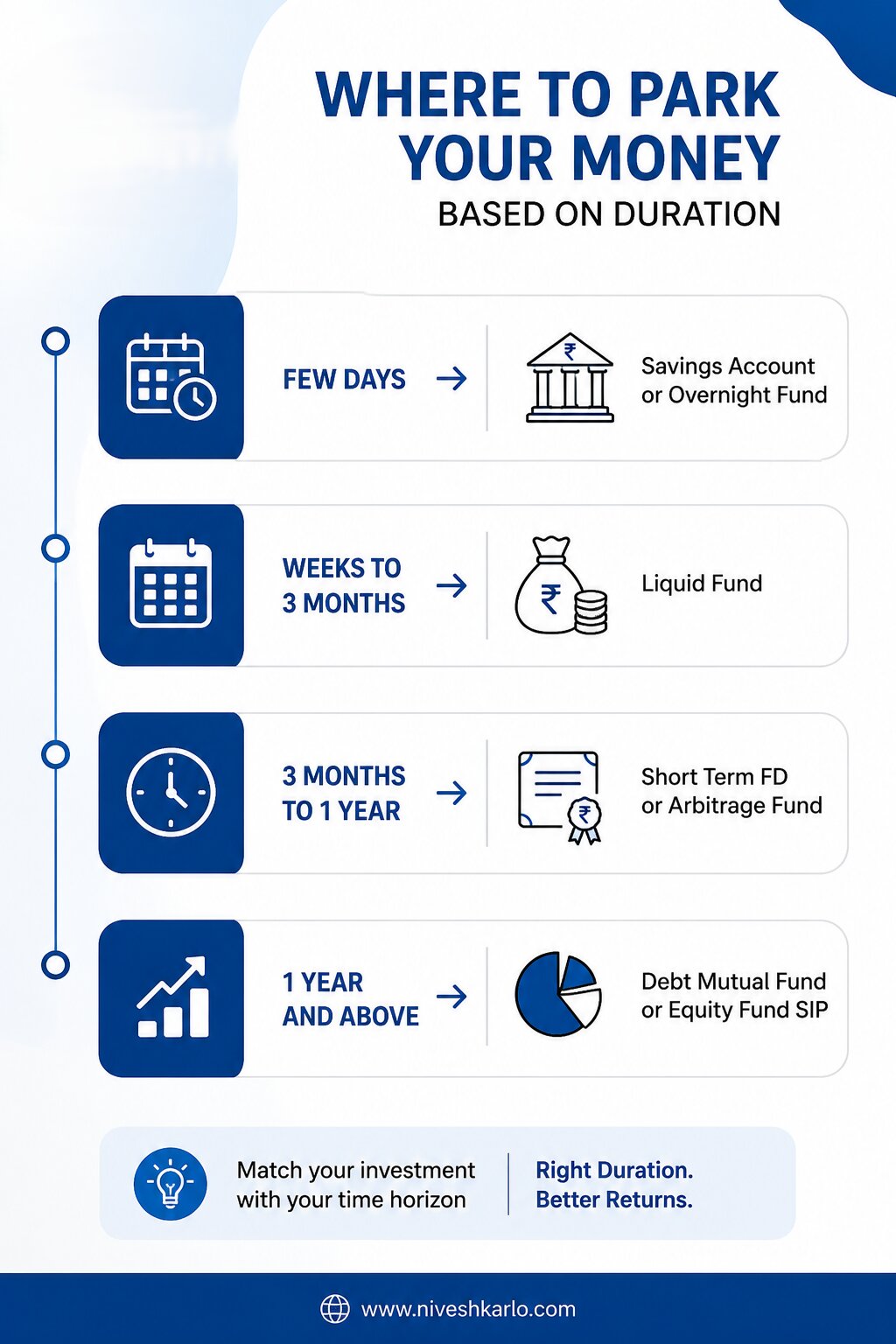
Image Source: AI
For 3 months to 1 year: short-term FD or arbitrage fund
Once you know the money won’t be touched for at least 3 months and up to a year, two options become more relevant than a liquid fund.
Short-term FD
A fixed deposit for 3–12 months at a bank or small finance bank. Major banks currently offer 6.25–6.75% for this range. Small finance banks offer higher rates — 7.5–9% — though deposits beyond ₹5 lakh per bank are not covered by DICGC insurance. If the amount is large, split across multiple banks to stay within the insurance limit. The trade-off with any FD: breaking it early costs 0.5–1% penalty on the rate. If there is any chance you will need the money before the FD matures, a liquid fund is safer.
Arbitrage fund
Arbitrage funds exploit price differences between the cash and futures markets for equity. They sound complex but behave like a very low-risk instrument — returns are currently 7–8% annualised and relatively stable. The key advantage: they are taxed as equity. Hold for more than 12 months and gains are LTCG at 12.5% above ₹1.25 lakh. Hold for 3+ months and exit — STCG applies at 20%, which is the same as equity STCG and typically lower than your income slab rate if you are in the 30% bracket. For someone in a higher tax slab parking money for 6–12 months, arbitrage funds can offer a better post-tax return than a liquid fund or FD at comparable returns. The community recommends checking this option specifically if you pay 30% income tax.
| 3 months to 1 year → short-term FD or arbitrage fund FD: Guaranteed return, DICGC insured up to Rs 5L, taxed at slab rate annually Arbitrage: ~7–8% returns, taxed as equity (better for high-tax-slab investors) If you may need the money early: liquid fund remains safer than FD (no premature withdrawal penalty). |
For 1 year or more: stop calling it short-term
If money is sitting for a year or more, it is not a short-term parking question anymore — it is an investment question. The right answer depends on what the money is for.
- For a goal 1–3 years away (down payment, car, trip): short-duration debt funds or recurring FDs. Avoid equity — the horizon is too short to absorb a market fall.
- For building wealth over 5+ years: equity mutual funds via SIP. See how to start a SIP investment — a fixed monthly amount, invested regardless of market levels, building a corpus over time.
- For an emergency fund (money you might need any time): split it. 1 month of expenses in the savings account for immediate access. 2–5 months in a liquid fund earning 6.5–7.5%. See our detailed guide on how much your emergency fund should be and where to keep it.
How to actually put money in a liquid fund in 10 minutes
Liquid funds are mutual funds — the same KYC process applies. If you have never invested in a mutual fund before, this is the one-time setup:
- Step 1 — KYC: Go to MF Central (mfcentral.com). Complete KYC with PAN, Aadhaar, and a selfie. Takes 10–15 minutes. Free. Applies to all mutual funds.
- Step 2 — Choose a liquid fund: Look for: large AUM (above ₹10,000 crore), portfolio rated A1+ or equivalent, direct plan expense ratio below 0.20%. Do not chase the highest return — in liquid funds, safety matters more than 10–20 basis points of extra yield.
- Step 3 — Invest in direct plan, growth option: Direct plans have no distributor commission. Growth option reinvests returns rather than paying them out. Both reduce costs and increase your corpus.
- Step 4 — Redeem when needed: Submit before 2 PM on a business day. Money arrives next business day. Keep the tax implications in mind when you file your ITR.
Also Read: Health Insurance Basics: What You Need to Know Before You Buy | Savings Account vs Fixed Deposit: Which Is Better for You?
Questions the community asks
Is a liquid fund safe for parking money?
SEBI regulates liquid funds strictly — they can only invest in instruments maturing within 91 days, issued by highly rated entities. Capital loss is extremely rare. However, liquid funds are not insured like bank deposits (DICGC covers bank FDs up to ₹5 lakh). For most short-term parking needs, the risk-return trade-off is appropriate. For money where even a 0.01% loss is unacceptable, the savings account or a bank FD within DICGC limits is safer.
What if I need the money urgently — can I get it the same day?
Some platforms offer instant redemption from liquid funds — up to ₹50,000 or 90% of the folio value (whichever is lower) credited to your bank account within minutes. For amounts above this, T+1 applies: request before 2 PM, money arrives next business day. For genuine same-day emergencies above ₹50,000, the savings account is more reliable. This is why keeping 1 month of expenses in a savings account — even if the rest is in a liquid fund — makes practical sense.
Is a liquid fund better than a savings account for an emergency fund?
For most of the emergency fund amount, yes. A liquid fund earning 6.5–7.5% is significantly better than a savings account at 2.5–3% for money you might need in a few days (T+1). The community’s standard recommendation: keep 1 month of expenses in the savings account for immediate access, and the remaining 2–5 months in a liquid fund. See our full guide on how much your emergency fund should be and how to structure it.
What about fixed deposits — aren’t they simpler?
Simpler, yes. Better for all situations, no. An FD is better when: (a) you know exactly when you will need the money, (b) you will not need it early, and (c) the bank’s FD rate is meaningfully higher than the liquid fund return. A liquid fund is better when the timing is uncertain or you may need early access — a liquid fund has no premature withdrawal penalty, while an FD loses 0.5–1% on the interest rate for early closure. For a fuller comparison, see our guide on savings account vs FD.
Do I need to show liquid fund gains in my ITR?
Yes. Liquid fund gains are capital gains and must be reported in your ITR for the financial year you redeem. There is no TDS deducted at source for resident individuals — you self-report. The gains are added to your income and taxed at your slab rate. For guidance on how to report investment gains in your return, see our guide on how to file ITR for salaried individuals.
Disclaimer: This article is for educational and informational purposes only. Liquid fund and overnight fund returns are market-linked and not guaranteed — past returns do not indicate future performance. Bank FDs are insured by DICGC up to ₹5 lakh per depositor per bank; mutual funds carry no such guarantee. Tax treatment cited is based on Budget 2023 changes, verified July 27, 2026. NiveshKarlo does not endorse any specific fund, bank, or platform. Please consult a SEBI-registered investment advisor before making investment decisions.

Hello there, my name is Phulutu, and I am the Head Content Developer at Nivesh Karlo. I have 13 years of experience working in fintech companies. I have worked as a freelance writer. I love writing about personal finance, investments, mutual funds, and stocks. All the articles I write are based on thorough research and analysis. However, it is highly recommended to note that neither Nivesh Karlo nor I recommend any investment without proper research, and to read all the documents carefully.