
Which Mutual Fund: Large Cap, Mid Cap or Small Cap?

Mid and small-cap funds beat large-cap 6X in June 2026. Investors are piling in. Here is why that is the wrong signal to act on — and how to actually think about allocating across these three categories.
Value Research reported on July 15, 2026 that mid and small-cap funds beat large-cap funds by 6X in June alone driven by FII inflows and a sharp domestic market recovery. AMFI data shows money pouring into mid and small-cap SIPs every month. The community question that follows is always the same: “Should I switch my SIP to a mid-cap or small-cap fund?”
The honest answer is: probably not based on that number. June’s outperformance tells you what happened it tells you nothing about what happens next. Small-cap funds fell 16.3% in 2018 when large-caps fell only 0.8%. The same funds that beat large-caps 6X in June 2026 were the ones hardest hit when markets corrected in late 2025.
The real question is not which category is performing best right now. It is which mix of all three categories is right for your specific situation your age, your investment horizon, and how you actually react when markets fall.
What SEBI actually defines — and the 2026 rule change
SEBI classifies every listed company into large-cap, mid-cap, or small-cap based on its rank by full market capitalisation. AMFI publishes this list every six months — the July 2026 revision set the thresholds at:
| Large-cap: Ranks 1 to 100 by market cap | Cutoff: ~₹1,06,300 crore Mid-cap: Ranks 101 to 250 | Cutoff: ~₹33,500 crore Small-cap: Ranks 251 and beyond | Below ₹33,500 crore Fund categorisation: Large-cap fund must invest at least 80% in large-cap stocks (SEBI rule). Mid-cap fund must invest at least 80% in mid-cap stocks (SEBI Feb 2026 — raised from 65% previously). Small-cap fund must invest at least 80% in small-cap stocks (SEBI Feb 2026 — raised from 65% previously). The February 2026 rule change matters: fund managers can no longer drift as freely across market caps during volatile markets. A mid-cap fund cannot pile into large-caps when things get rough. It must hold mid-caps. |
This tightening is important for investors. Before 2026, a fund labelled ‘mid-cap’ could hold 35% in large-cap stocks, which cushioned returns but made the category meaningless as a portfolio construction tool. Now, when you buy a mid-cap fund, you are genuinely getting mid-cap exposure — not a blended large-and-mid fund hiding behind a label.
What you are actually buying in each category
Large-cap funds — the top 100 companies
Large-cap stocks are the 100 largest listed companies by market cap — Reliance, TCS, HDFC Bank, Infosys, and their peers. These are businesses with decades of operating history, stable earnings, and high analyst coverage. Large-cap funds are required to hold at least 80% in these stocks. They are the least volatile equity category, but they are also the least likely to produce returns that surprise you. For many investors, a Nifty 50 index fund is a better large-cap choice than an actively managed large-cap fund — because most active large-cap funds have failed to beat the Nifty 50 index consistently over 10 years, while charging 1–2% more in expenses. If you want large-cap exposure, the index fund route is worth considering first.
Mid-cap funds — companies ranked 101 to 250
Mid-cap stocks are established companies that are too big to be called startups but too small to sit in the top 100. Think of businesses in their expansion phase past the risky early years, still growing faster than the large-cap giants. Mid-cap funds have historically delivered higher returns than large-cap funds over long periods, with meaningfully more volatility along the way. A 20–30% fall in a bad year is not unusual for the mid-cap category. The February 2026 SEBI rule change means you are now getting genuine mid-cap exposure, not a softened large-and-mid blend.
Small-cap funds companies ranked 251 and beyond
Small-cap stocks are where the most growth potential sits and the most risk. These are companies outside the top 250, many of them regional businesses, niche manufacturers, and sector specialists that have not yet been discovered by large institutional investors. Small-cap funds have delivered the highest long-term returns of the three categories, with a category average CAGR of 17.2% over 3 years. They have also delivered the sharpest falls down 16.3% in 2018 while large-caps fell less than 1%. Liquidity in small-cap stocks is thinner, which means fund flows in and out of the category can themselves move stock prices.
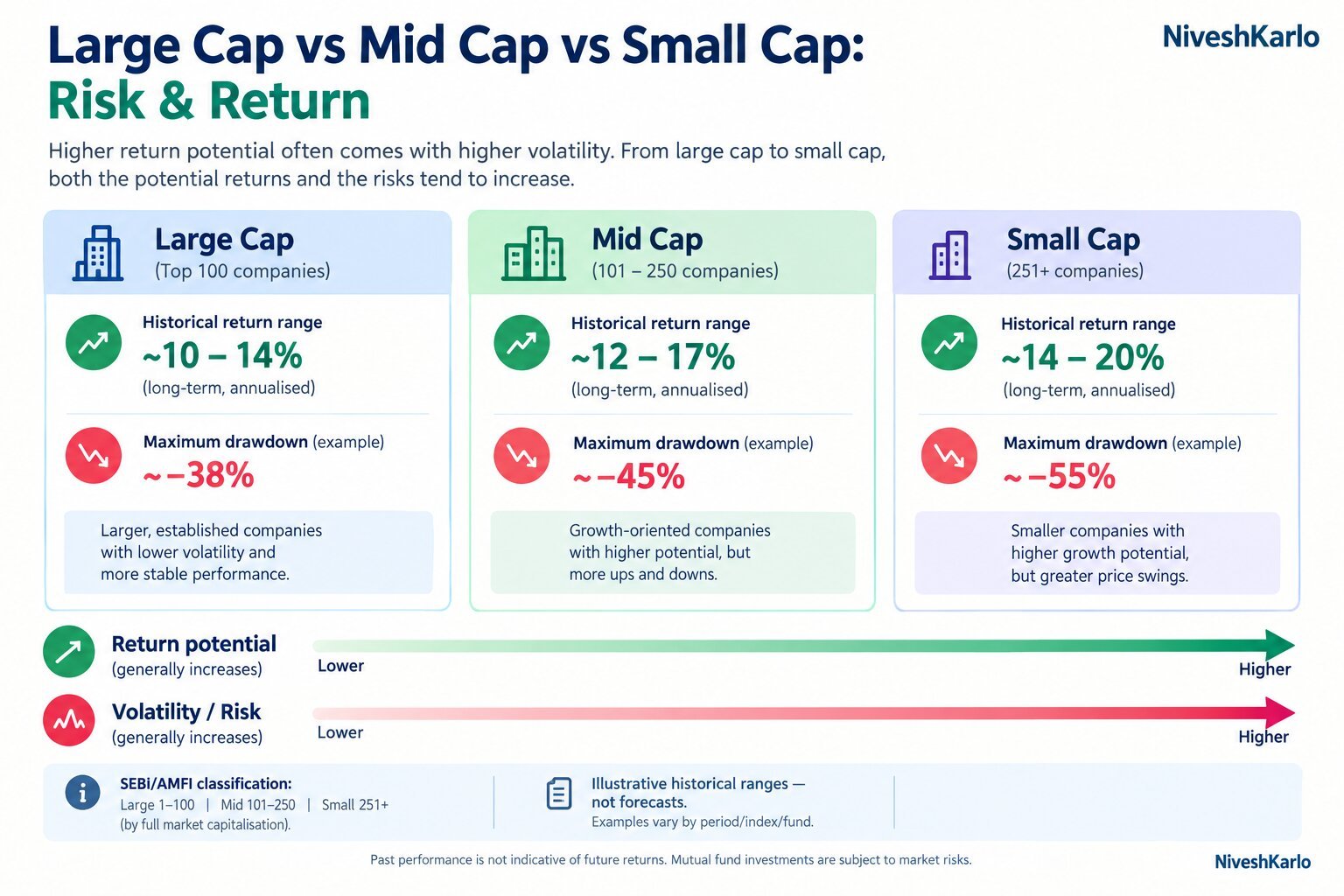
Image Source: AI
What the return data actually shows
| Large-cap | Mid-cap | Small-cap | |
| SEBI rank range | 1–100 | 101–250 | 251+ |
| Min. equity in category (SEBI 2026) | 80% | 80% | 80% |
| AUM (August 2025) | ₹3.90 lakh crore | ₹4.27 lakh crore | ₹3.51 lakh crore |
| AUM growth YoY | +5.86% | +10.9% | +9.56% |
| 3-year category average CAGR | ~13–14% | ~18–20% | ~17.2% |
| Worst calendar year (2018) | −0.8% | −10.5% | −16.3% |
| Volatility (standard deviation) | Low | Moderate-High | High |
| Index fund alternative available? | Yes — Nifty 50, Nifty 100 | Yes — Nifty Midcap 150 | Yes — Nifty Smallcap 250 |
The 3-year return figures are from a period that includes the post-COVID recovery (2020–2022) and the 2024–2025 bull market. Both were periods that strongly favoured mid and small-cap stocks. Over longer periods (10–15 years), the return gap between categories narrows significantly, while the volatility difference remains. Chasing 3-year returns is how investors end up buying mid and small-cap funds at peak valuations.
The allocation question — not ‘which one’ but ‘how much of each’
The question most investors actually need answered is not ‘large-cap or small-cap?’ It is ‘how much of each, given my situation?’ The right mix depends on three things: how long you will hold, how you react when portfolios fall, and whether you have anything else in your portfolio.
Horizon under 5 years
Stick to large-cap funds or index funds. Mid and small-cap funds need 7+ years to smooth out the volatility and give their returns a chance to show up. Investing in small-cap funds with a 3-year horizon and pulling out after a correction is the worst possible outcome you get all the downside and none of the long-term upside.
Horizon 7–10 years
A simple allocation that financial planners frequently cite: 60% large-cap (or a Nifty 50 index fund) + 25% mid-cap + 15% small-cap. This gives you stability from the large-cap core while letting the mid and small-cap allocation work over time. If you have no appetite for seeing a 20% portfolio fall in a bad year, reduce mid and small-cap allocation further. If what happens to your SIP during a market fall makes you anxious, start with a larger large-cap allocation and work up gradually.
Horizon 15+ years
A higher mid and small-cap allocation can work some planners suggest up to 40–50% combined in mid and small-cap for very long horizons with high risk tolerance. But this is only appropriate if you genuinely won’t touch the money and won’t stop your SIP when the portfolio falls 30%. The power of SIP over time is maximised in volatile categories precisely because more units are bought at lower prices during falls — but only if you stay invested.
| Suggested starting allocation by horizon: Under 5 years: 100% large-cap or index fund 7–10 years: 60% large-cap / 25% mid-cap / 15% small-cap 15+ years: 50% large-cap / 30% mid-cap / 20% small-cap These are starting points not rules. Adjust based on your actual comfort with a 25–30% portfolio fall in a bad year. Review allocation every 2–3 years, not every month. |
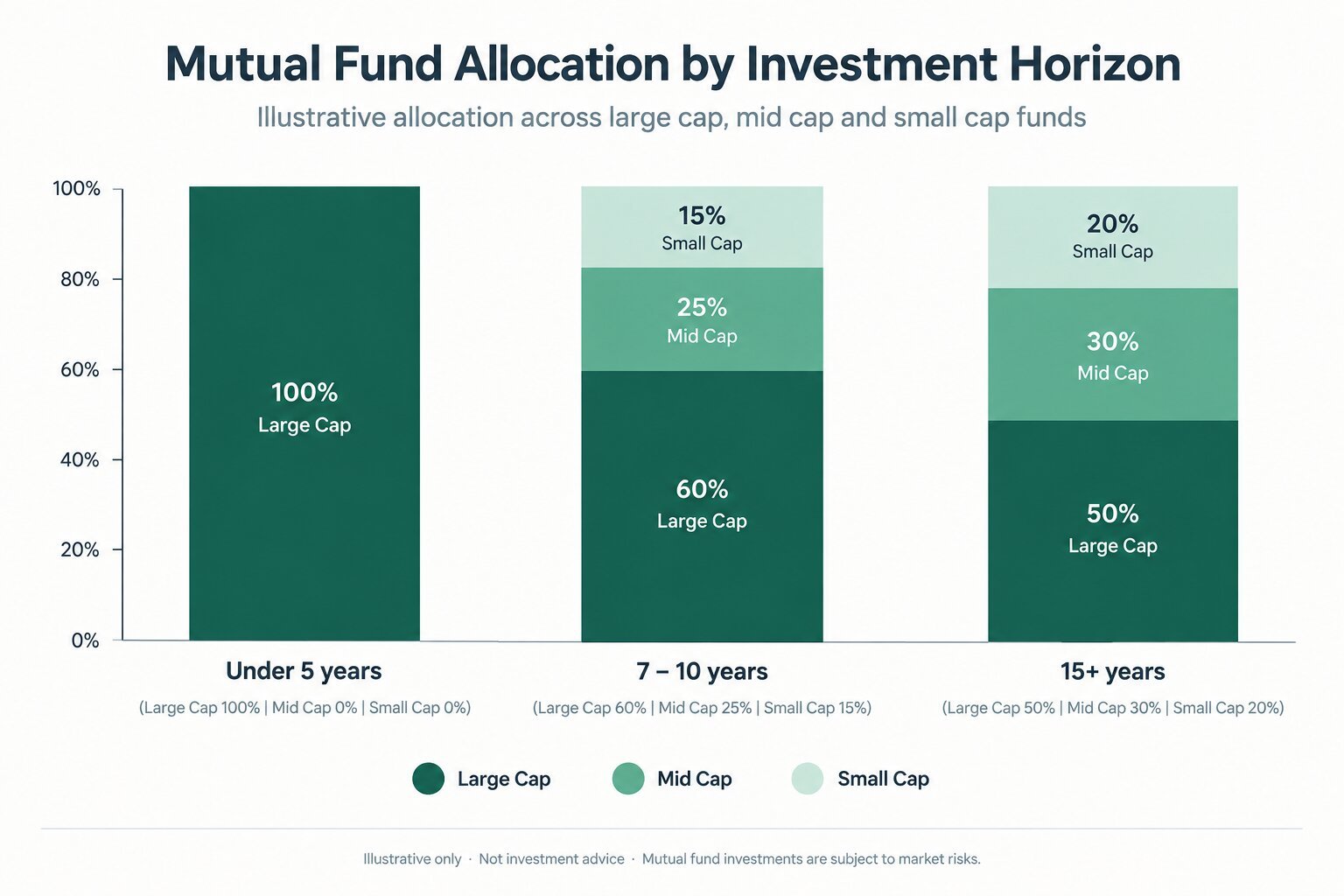
Image Source: AI
One thing most allocation guides miss: index funds for large-cap
For the large-cap portion of your allocation, an actively managed large-cap fund is rarely the best vehicle. SEBI data shows that most active large-cap funds have failed to consistently beat the Nifty 50 Total Return Index over 10-year periods — while charging 1.0–1.5% more in expenses than a direct plan index fund. A Nifty 50 or Nifty 100 index fund at 0.05–0.20% expense ratio gives you the same large-cap exposure for a fraction of the cost.
Mid-cap and small-cap are different. Active managers have historically added more value in these categories because the stocks are less covered by analysts, pricing inefficiencies are larger, and fund manager skill has a bigger impact on outcomes. The case for active mid and small-cap funds is stronger than the case for active large-cap funds. See our detailed guide on index funds and our comparison of direct vs regular mutual fund plans for more on how costs compound over time.
Also Read: Do You Need a Demat Account to Invest in Mutual Funds? | Where to Park Money for a Few Days, Months, or Years
Questions people ask about large, mid, and small-cap funds
Which category gives the best returns?
Small-cap funds have the highest long-term return potential — category 3-year CAGR of 17.2%, versus mid-cap at 18–20% and large-cap at 13–14%. But these figures come from a period that strongly favoured mid and small-cap stocks. Over 15–20 year periods, the gap narrows. More importantly, small-cap funds have the worst drawdowns — down 16.3% in 2018 vs large-cap’s 0.8% fall. The ‘best returns’ category also comes with the worst pain during corrections.
Is a flexi-cap or multi-cap fund better than choosing separately?
A flexi-cap fund lets the fund manager decide the allocation across all three categories — they can go 100% large-cap during a correction and rotate to mid and small-cap when valuations recover. A multi-cap fund must maintain at least 25% each in large, mid, and small-cap. Both are valid alternatives to building your own allocation, but they come with a trade-off: you give up control over the mix. If you want a simple single-fund solution, a flexi-cap from a fund house with a strong track record is worth considering. See our guide on how to analyse a mutual fund for what to check before choosing any equity fund.
Should I stop my large-cap SIP and shift to mid or small-cap?
This comes up every time mid and small-cap funds outperform. The answer is almost always no — and the timing is particularly wrong when mid and small-cap funds have just had a strong run. Switching after outperformance means buying at higher valuations. If your allocation is genuinely underweight in mid and small-cap relative to your horizon and risk tolerance, increase it gradually — start a new SIP in a mid or small-cap fund rather than stopping the existing one. Stopping a running SIP breaks the disciplined investment habit that is the entire point of the SIP mechanism.
What happened to small-cap funds in 2025?
Small-cap funds fell significantly in the second half of 2025 as FIIs sold and market valuations in the mid and small-cap space contracted. Several small-cap funds saw 20–25% drawdowns from their 2024 highs. This is the nature of the category — the same stocks that rise the fastest in a bull market fall the hardest in a correction. Investors who held through this and continued their SIPs are in a better position in mid-2026 because they accumulated units at lower prices during the fall. Investors who stopped their SIPs missed the recovery.
Is there a SEBI rule change I should know about for 2026?
SEBI’s February 2026 circular raised the minimum equity investment requirement for mid-cap and small-cap funds from 65% to 80% in their respective market-cap buckets. This means mid-cap funds must now hold at least 80% of their portfolio in stocks ranked 101–250, and small-cap funds must hold at least 80% in stocks ranked 251+. The practical effect: these funds can no longer drift as freely into large-cap stocks when markets get volatile. You are now getting the category exposure you pay for.
Mid and small-cap funds beat large-caps 6X in June 2026. That is not a reason to change your allocation. It is a reason to check whether your current allocation was right to begin with — and if it was, to leave it alone. The investors who do well in mid and small-cap categories over the long run are the ones who built their allocation when these funds were not the headline story, and held through the corrections that inevitably followed the headline moments.

Hello there, my name is Phulutu, and I am the Head Content Developer at Nivesh Karlo. I have 13 years of experience working in fintech companies. I have worked as a freelance writer. I love writing about personal finance, investments, mutual funds, and stocks. All the articles I write are based on thorough research and analysis. However, it is highly recommended to note that neither Nivesh Karlo nor I recommend any investment without proper research, and to read all the documents carefully.