Paying Only the Minimum Due on Your Credit Card? Here Is What It Costs

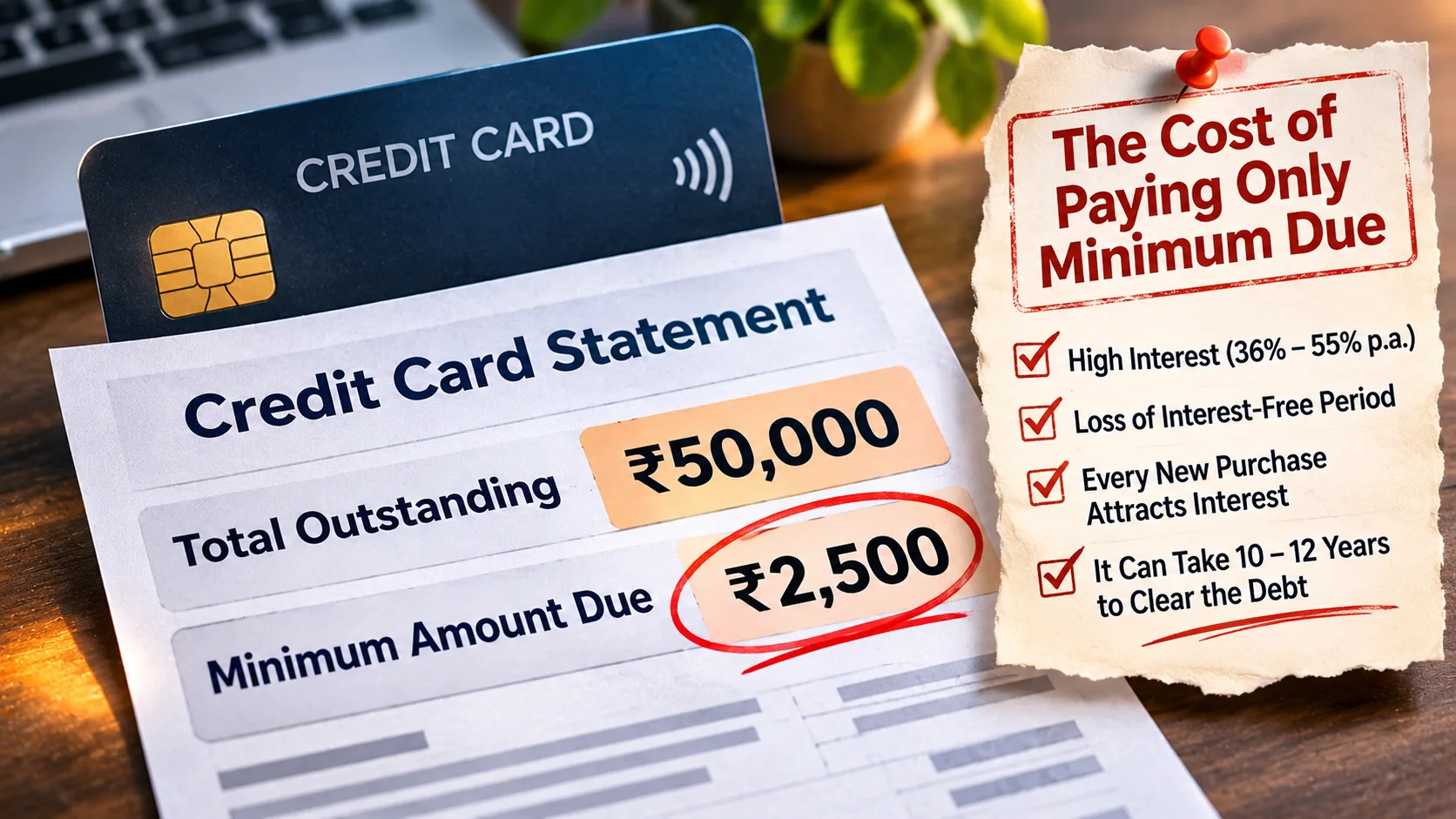
Your credit card bill arrives. The total outstanding is Rs 50,000. The minimum amount due shown is Rs 2,500. You pay Rs 2,500, feel like you’ve handled it, and move on.
What the bill does not show you is what happens next. That Rs 47,500 you left unpaid is now accruing interest at anywhere between 36% and 55% per year, depending on your bank. The interest-free grace period you thought you had on new purchases? Gone. Every transaction from that point forward starts attracting interest from day one.
This article shows you exactly what minimum due payments cost – month by month, rupee by rupee – using real rates from actual Indian banks. Not an approximation. Not a warning. The calculation.
What the Minimum Due Actually Is
The minimum amount due on an Indian credit card is typically the higher of two things: 5% of the total outstanding balance, or Rs 200. Some banks set it at a flat 5% of the statement balance. Others include overdue EMI instalments, fees, and interest already accrued on top of that 5%.
The RBI’s Master Directions on Credit Cards (2022, updated 2024) require banks to disclose the minimum due clearly on every statement. What those directions do not cap is the interest rate banks can charge on the revolving balance – which is where the real cost lives.
Paying the minimum due does three things simultaneously:
- It protects your credit score from a late payment mark
- It keeps your card active and your credit limit intact
- It triggers full interest charges on the entire unpaid balance – not just the part you did not pay
That third point is the one most people miss. If your bill is Rs 50,000 and you pay Rs 2,500, you do not pay interest only on Rs 47,500. At most banks, interest is calculated on the average daily balance for the full cycle – which effectively means you are paying interest on the original Rs 50,000 from the date of each transaction.
What Banks Actually Charge: Real Rates, Not Estimates
Every competitor article on this topic uses a vague “36-48% annually” range. Here are the verified rates from actual Indian banks, sourced from BankBazaar’s credit card rate listings:
| Bank | Monthly Rate | Annual Rate (APR) | Source |
| HDFC Bank | Up to 3.40% | Up to 40.8% | BankBazaar / HDFC |
| SBI Card | Up to 3.75% | Up to 45% | BankBazaar / SBI |
| Kotak Mahindra | Up to 3.75% | Up to 45% | BankBazaar / Kotak |
| Axis Bank | Up to 4.90% | Up to 55.55% | BankBazaar / Axis |
Your actual rate depends on your card type and credit profile. The rates above are maximums. But most mass-market cards for salaried individuals sit between 3.35% and 3.75% per month. The calculation below uses 3.5% monthly – a mid-range figure that reflects what a typical cardholder on a standard HDFC, SBI, or Kotak card actually pays.
The Month-by-Month Calculation on a Rs 50,000 Bill
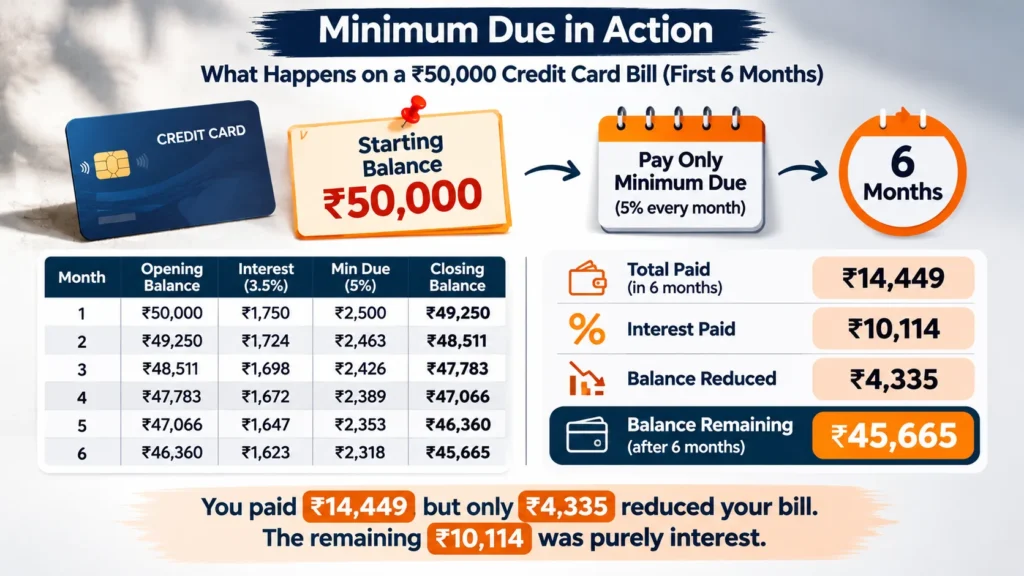
Assumptions used in this calculation:
- Opening balance: Rs 50,000
- Monthly interest rate: 3.5%
- Minimum due: 5% of outstanding balance each month
- No new purchases made during this period
| Month | Opening Balance | Interest (3.5%) | Min Due Paid (5%) | Closing Balance | Total Paid |
| 1 | Rs 50,000 | Rs 1,750 | Rs 2,500 | Rs 49,250 | Rs 2,500 |
| 2 | Rs 49,250 | Rs 1,724 | Rs 2,463 | Rs 48,511 | Rs 4,963 |
| 3 | Rs 48,511 | Rs 1,698 | Rs 2,426 | Rs 47,783 | Rs 7,389 |
| 4 | Rs 47,783 | Rs 1,672 | Rs 2,389 | Rs 47,066 | Rs 9,778 |
| 5 | Rs 47,066 | Rs 1,647 | Rs 2,353 | Rs 46,360 | Rs 12,131 |
| 6 | Rs 46,360 | Rs 1,623 | Rs 2,318 | Rs 45,665 | Rs 14,449 |
After 6 months of paying every minimum due on time: you have paid Rs 14,449 out of pocket. Your balance has dropped by just Rs 4,335 – from Rs 50,000 to Rs 45,665. Of that Rs 14,449 paid, Rs 10,114 went purely to interest. You have cleared less than 9% of the original bill.
At this pace, paying only the minimum due every month, it would take roughly 10-12 years to clear Rs 50,000. Total interest paid over that period: upwards of Rs 60,000 – more than the original bill itself. This is consistent with CRIF High Mark data showing credit card delinquencies rose 44.3% YoY to Rs 33,886.5 crore as of March 2025 – a direct result of the minimum due trap at scale.
The Grace Period Mechanic Nobody Explains Clearly
The interest-free grace period on a credit card – typically 20 to 50 days depending on your billing cycle – is not a permanent feature. It is conditional.
The condition: you must pay the previous month’s statement balance in full.
The moment you pay only the minimum due – even once – two things happen immediately:
- Interest starts accruing on the unpaid balance from the original transaction dates, not from the due date
- Every new purchase you make from that point forward also starts attracting interest immediately – there is no interest-free window on new spending until you clear the full outstanding
This is the mechanic that makes minimum due payments particularly expensive for people who continue using the card normally. You are not just paying interest on old debt – you are paying interest on new spending too, from day one of each transaction.
What This Looks Like If You Keep Using the Card
The calculation above assumes you make no new purchases. Most people do not stop spending after paying the minimum due. Here is what adding just Rs 10,000 of new spending per month does to the same Rs 50,000 starting balance:
- Month 1: Pay Rs 2,500 minimum due. Add Rs 10,000 new spend. Balance becomes roughly Rs 59,250 after interest on both old and new balances
- Month 2: Minimum due rises to Rs 2,963. Balance climbs further
- Month 6: Balance has grown to over Rs 55,000 despite paying Rs 15,000+ in minimum payments
The balance does not fall. It grows. This is the debt spiral that the minimum due is designed to allow – not because banks are concealing it, but because the math of compounding at 3.5% monthly is simply stronger than 5% repayment on a rising base.
What You Should Do If You Cannot Pay the Full Amount
Full payment is the only way to avoid interest entirely. But if full payment is not possible this month, there is a priority order that minimises damage. If you are thinking about where to put the money you free up once you clear the balance, see our guide on the best investment plan for a salaried person.
Pay as much above the minimum as possible
Every rupee above the minimum directly reduces the balance on which next month’s interest is calculated. Paying Rs 10,000 instead of Rs 2,500 on a Rs 50,000 bill reduces the interest charge next month by roughly Rs 262 – and that compounds forward.
Convert the outstanding to an EMI
Most banks offer an EMI conversion on the outstanding balance at 14-24% annually – significantly cheaper than the 36-45% revolving interest. There is a processing fee (typically 1-2%), but on a large outstanding, the savings are substantial. This also restores your grace period on new purchases. Note that an FD from which the bank deducts TDS still earns 6-7% net – which is nowhere near enough to offset 40% card interest, so do not keep an FD while carrying a revolving credit card balance.
Use a personal loan to clear the card balance
Personal loan rates from banks currently range from 10-18% annually. If your credit card outstanding is large and you cannot clear it quickly, shifting it to a personal loan at 14% and clearing the card entirely is mathematically cheaper than revolving at 40%. Once the card is clear, that same monthly outgo – redirected toward a balanced advantage fund or a large-cap SIP – compounds in your favour instead of the bank’s.
Stop all new card spending until the balance is cleared
As long as you carry a revolving balance, new purchases attract interest from day one. Stopping new spend is not optional if you want to get out of the cycle.
At a Glance: Minimum Due vs Full Payment
| Minimum Due Only | Full Payment | |
| Interest charged | Yes – on full balance | None |
| Grace period on new purchases | Lost immediately | Retained |
| CIBIL score impact | Neutral (no late mark) | Positive |
| Time to clear Rs 50,000 | 10-12 years | Immediate |
| Total interest paid | Rs 60,000+ | Zero |
Questions People Ask About Minimum Due
Does paying the minimum due affect my CIBIL score?
Paying the minimum due on time does not create a late payment mark on your credit report. Your CIBIL score stays protected from a delinquency flag. What it does not protect you from is a rising credit utilisation ratio – if your balance keeps growing because you are only paying the minimum, your utilisation climbs, which does hurt your score over time.
Is the minimum due calculated on the total outstanding or the current month’s spend?
It is calculated on the total outstanding balance on your statement date – not just what you spent this month. If you carried a balance from last month and added new spend, the minimum due applies to the combined total.
What happens if I miss even the minimum due?
Missing the minimum due triggers a late payment fee (typically Rs 100 to Rs 1,300 depending on your bank and outstanding amount), a late payment mark on your credit report, and in some cases a penalty interest rate higher than the standard revolving rate. One missed payment can lower your CIBIL score by 50-100 points.
Can I negotiate the interest rate with my bank?
Yes, and it is worth trying – especially if you are a long-standing customer with a good payment history. Banks have hardship programs and can sometimes reduce rates or waive charges for customers who call and explain their situation. This is not widely advertised, but the option exists.
The Direct Answer
Paying the minimum due is not a neutral act. It is an agreement to borrow the remaining balance at 36-55% annually from your bank. On a Rs 50,000 bill, that costs you over Rs 10,000 in interest in the first six months alone – before your balance has dropped by even 10%.
Banks show you the minimum due because it keeps your account current and their interest income flowing. The number is not designed to help you get out of debt. It is designed to be small enough to pay without discomfort – and large enough that your balance falls slowly enough for the interest clock to keep running.
The rule is simple: pay the full statement balance every month. If you cannot this month, pay as much above the minimum as you can, stop new spending on the card, and look at EMI conversion as the next best option. The minimum due is a floor, not a target. Once the balance is clear, every rupee that was going toward interest can go toward building something – a SIP in a large-cap or mid-cap fund, or a gold ETF as a hedge. That is the trade-off worth making.

Hello there, my name is Phulutu, and I am the Head Content Developer at Nivesh Karlo. I have 13 years of experience working in fintech companies. I have worked as a freelance writer. I love writing about personal finance, investments, mutual funds, and stocks. All the articles I write are based on thorough research and analysis. However, it is highly recommended to note that neither Nivesh Karlo nor I recommend any investment without proper research, and to read all the documents carefully.