
What is the best investment plan for a salaried person earning 10 lakh in 2026?

At ₹10 lakh, your effective tax under the new regime is zero. That means the entire conversation is about what to do with your take-home — not how to save tax. Here is the priority order that actually makes sense.
The first thing most articles about a ₹10 lakh salary tell you is: ‘Here are the best ways to save tax.’ The problem with that advice in 2026 is that you may not have any tax to save.
Under the new tax regime — the default since FY 2023-24 — a salaried individual earning ₹10 lakh gross pays zero effective tax. The ₹75,000 standard deduction brings taxable income to ₹9.25 lakh. The Section 87A rebate (₹60,000) wipes out the entire tax liability. Your tax bill: ₹0. Which means the investment conversation is not about which 80C product to buy. It is about what to do with the money that arrives in your account each month.
This article answers that question in the correct order — not the order that sells the most products.
What ₹10 lakh actually looks like in your account every month
₹10 lakh per annum is ₹83,333 per month gross. Your actual take-home is lower — primarily because of EPF deduction. EPF (Employees’ Provident Fund) is mandatory for most private sector employees earning below ₹15,000 basic, though many employers continue it even above that threshold. The employee contributes 12% of basic salary, and the employer matches it.
| Component | Approximate monthly figure |
| Gross monthly salary | ₹83,333 |
| Less: EPF (employee) — 12% of basic (assume basic = 40% of CTC) | −₹4,000 |
| Less: Professional tax (varies by state, ~₹200) | −₹200 |
| Monthly take-home (approximate) | ₹79,133 |
| Annual take-home (12 months) | ~₹9.50 lakh |
This is the number you actually work with. The EPF deduction is not a loss — it is an investment in itself (employer also contributes 12%, returns at 8.25% p.a. tax-free). But it is not discretionary, so the investable surplus from your salary is approximately ₹79,000/month — not ₹83,333.
For the tax regime question at this income level: our old vs new regime comparison shows that with fewer than ₹3.75 lakh in deductions, the new regime is cheaper. At ₹10 lakh, the new regime is almost always the right choice — and with it, your tax is zero. File your declaration with HR at the start of the year, and no tax gets deducted from your salary.
The correct priority order — before you think about returns
Most investment advice starts with products. The right framework starts with priorities. Here is the sequence that makes the most financial sense at a ₹10 lakh salary, before returns become the primary consideration:
| Priority 1: Emergency fund — 3 to 6 months of expenses, liquid and accessible Priority 2: Term life insurance — if you have dependents Priority 3: Health insurance — personal cover, separate from employer group policy Priority 4: SIP in equity mutual funds — for long-term wealth building Priority 5: NPS (optional) — for additional retirement corpus Priority 6: Everything else — gold, FD, PPF, real estate The reason this order matters: Priorities 1–3 are protective. A single medical emergency or job loss without these in place can derail everything built in Priority 4 onwards. |
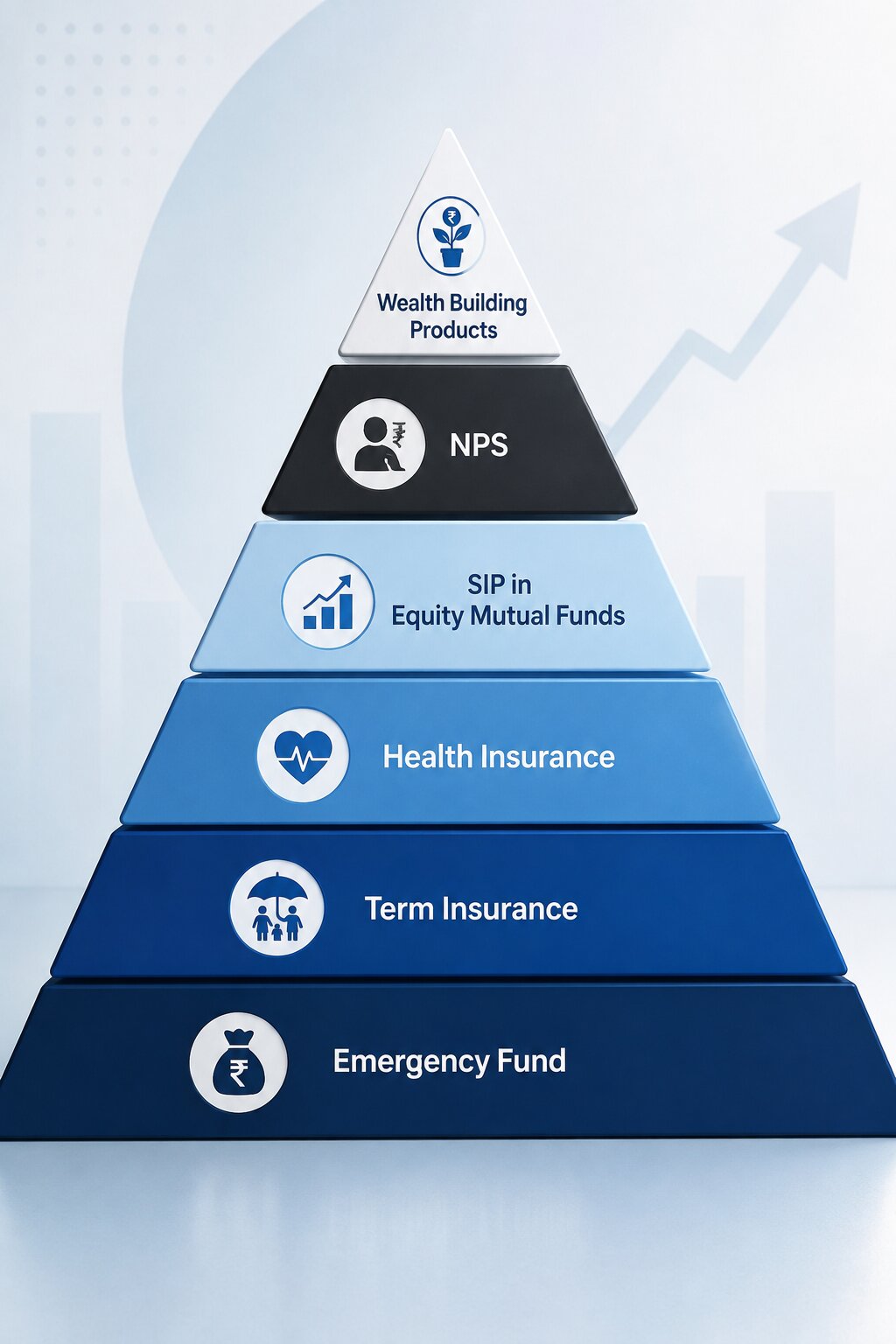
Image Source: AI
Priority 1: Emergency fund — before anything else
An emergency fund is 3–6 months of your total monthly expenses — not income — kept in an accessible, liquid instrument. At ₹79,000 take-home with typical expenses of ₹40,000–50,000/month for a metro resident, this means keeping ₹1.5–3 lakh in a liquid, accessible form.
Where to keep it: a combination of savings account (1 month) and liquid mutual fund (2–5 months). Our guide on where to park money short-term covers this in detail — liquid funds currently earn 6.5–7.5% annualised versus 2.5–3% in a savings account, with next-day access. See also our complete guide on how much your emergency fund should be.
Until this is in place, no money goes into equity mutual funds, NPS, or any locked instrument. This is not a suggestion — it is a structural requirement. A SIP that gets redeemed at a loss during a job loss negates years of compounding.
Priority 2: Term life insurance — if you have dependents
If anyone depends on your income — spouse, children, parents — a term insurance policy is not optional. At a ₹10 lakh salary, the recommended cover is 15–20x annual income: ₹1.5–2 crore. For a 30-year-old non-smoker, a ₹1 crore term policy costs approximately ₹8,000–12,000 per year — less than ₹1,000 per month.
Buy it now, not later. Premiums are locked at the age of purchase for level-term policies. A policy bought at 30 costs significantly less annually than the same policy bought at 35 — the five years of delay compounds into permanently higher premiums. Our guide on how much term insurance cover you actually need walks through three calculation methods — income replacement, HLV, and needs-based — to arrive at the right number for your specific situation.
Priority 3: Personal health insurance — separate from your employer
Your employer’s group health policy covers you while you are employed. It ends the day you resign, are laid off, or the company switches insurers. Medical inflation is currently running at 14% annually — a hospitalisation that costs ₹5 lakh today will cost ₹10 lakh in five years. A personal health policy of ₹10 lakh minimum for an individual (₹25 lakh for a metro) costs approximately ₹8,000–15,000 per year for someone in their late 20s to mid-30s.
Buy it young, before any conditions develop that would increase premiums or create exclusions. See our complete guide on health insurance basics for what to look for in a policy — specifically room rent capping, co-pay clauses, and claim settlement ratio.
Priority 4: SIP in equity mutual funds — the wealth-building engine
Once Priorities 1–3 are in place, the ₹10 lakh salary provides meaningful investable surplus for long-term wealth building. The question is not whether to invest in equity mutual funds — for a 10+ year horizon, equity has historically provided the best inflation-beating returns. The question is how much and in what.
How much to invest
A reasonable starting allocation at this salary level, after EPF and protection are in place:
| Item | Monthly amount | Annual amount |
| EPF (already deducted) | ₹4,000 | ₹48,000 |
| Term insurance premium | ~₹833 | ~₹10,000 |
| Health insurance premium | ~₹1,000 | ~₹12,000 |
| Emergency fund (build over 6 months) | ₹8,000–10,000 (one-time phase) | — |
| SIP in equity mutual funds | ₹10,000–15,000 | ₹1.2L–1.8L |
| Liquid fund / short-term buffer | ₹3,000–5,000 | ₹36,000–60,000 |
At ₹10,000/month SIP starting at age 28, over 25 years at a 12% CAGR (illustrative), the estimated corpus is approximately ₹1.9 crore. At ₹15,000/month, it is approximately ₹2.8 crore. Our detailed guide on the power of SIP over time shows exactly what different monthly amounts become at different time horizons — worth reading before deciding how much to commit.
What type of fund
For a first-time investor starting a SIP at this income level, a simple two-fund portfolio is sufficient: a Nifty 50 or Nifty LargeMidcap 250 index fund for the core, and optionally a flexi-cap or mid-cap fund for the satellite. Always in direct plans — the lower expense ratio compounds into a meaningfully larger corpus over 20 years. For guidance on evaluating funds, see our guide on what is SIP and how it works.
Priority 5: NPS — the optional retirement booster
The National Pension System (NPS) is worth considering once your SIP is running. Under the new tax regime, your own NPS contributions under Section 80CCD(1B) are not deductible — but if your employer offers NPS contributions under Section 80CCD(2), that deduction survives the new regime at up to 14% of basic salary. Ask HR whether employer NPS is available as part of your CTC restructuring.
NPS funds are locked until retirement (60 years) with partial withdrawal allowed under specific conditions. This makes it appropriate only for money you will not need before then. As a retirement supplement to EPF — not a replacement for your SIP — NPS is a reasonable addition at this salary level once the higher priorities are covered.
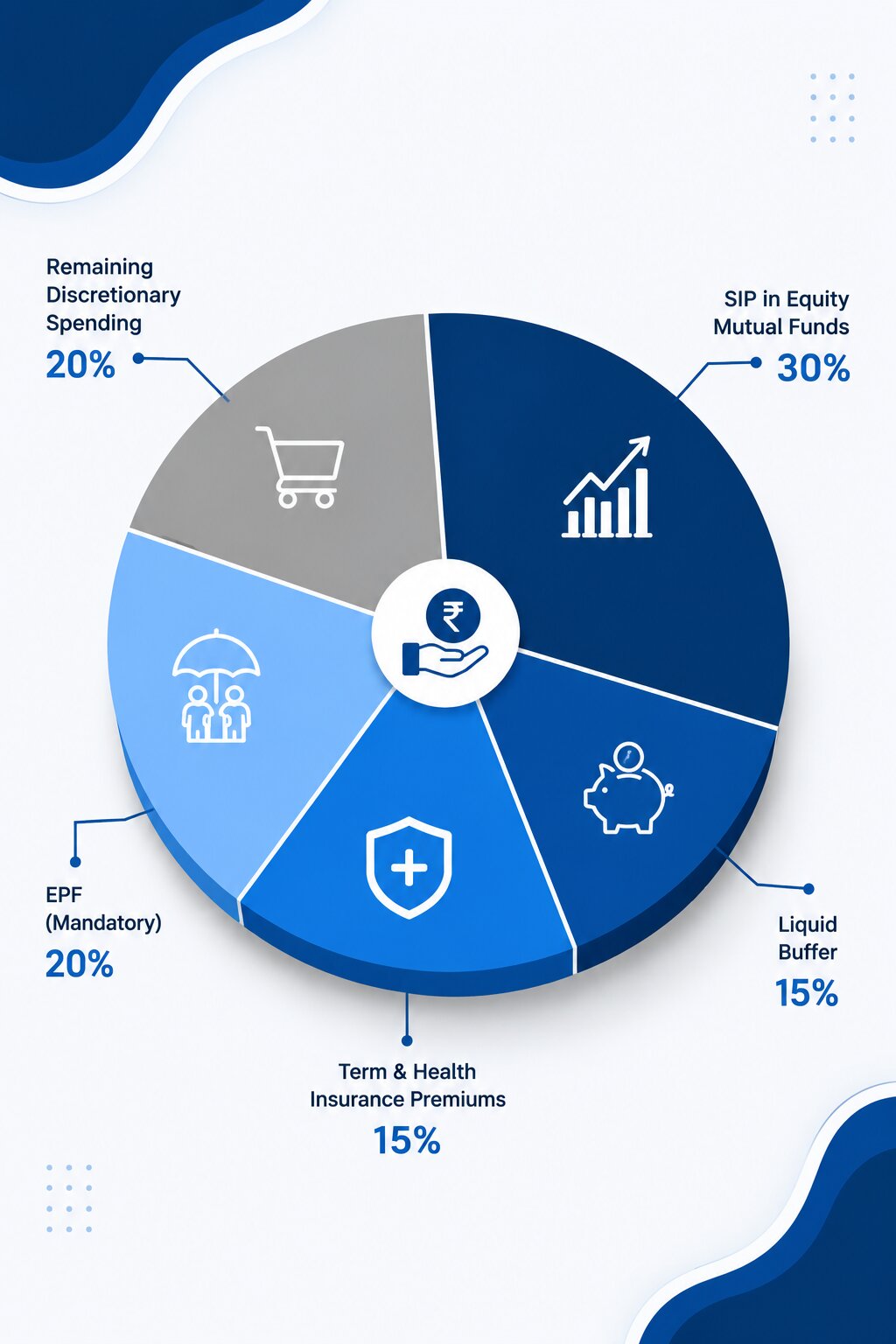
Image Source: AI
What not to do — the products that distract from this plan
At a ₹10 lakh salary in the new regime, several products are frequently pushed that do not belong in this plan:
- ULIP (Unit Linked Insurance Plans): These combine insurance and investment — doing neither optimally. The charges in the first 3–5 years are high, the insurance component is expensive relative to pure term cover, and the investment returns trail comparable mutual funds. Separate insurance (term) from investment (mutual funds).
- Traditional LIC endowment policies: Returns are typically 4–6% pre-tax. With inflation at 4–5% and medical inflation at 14%, these policies do not build real wealth. They may make sense for capital preservation needs in very specific situations — but not as a primary investment vehicle at this salary level.
- Tax-saving FDs under 80C: Under the new regime, you have zero tax liability at this salary level. There is no 80C deduction to claim. A tax-saving FD serves no purpose here — the lock-in is a cost without a benefit.
- Real estate as first investment: A home loan EMI of ₹30,000–40,000/month at a ₹10 lakh salary leaves little room for the protection and investment priorities above. Real estate may make sense later — when the protective foundation is in place, income has grown, and the EMI does not crowd out SIP and insurance.
Questions people ask about investing at a ₹10 lakh salary
Do I pay any income tax on a ₹10 lakh salary in FY 2026-27?
Under the new tax regime, effectively no. The ₹75,000 standard deduction reduces taxable income to ₹9.25 lakh. The Section 87A rebate (₹60,000) then wipes out the entire tax liability. You are required to file an ITR — the return is mandatory for income above ₹3 lakh — but the tax payable is ₹0. Declare the new regime to your employer at the start of the year and no TDS will be deducted from your salary.
Should I choose the old or new tax regime at ₹10 lakh salary?
At ₹10 lakh, the new regime is almost always better. Under the new regime, your tax is zero. Under the old regime, to achieve the same zero-tax outcome, you would need to claim deductions exceeding the gap — which requires locking money into 80C instruments, home loan interest, HRA, and others. Our full comparison at old vs new tax regime shows the break-even points at different salary levels. At ₹10 lakh specifically, unless you have a large home loan or pay significant rent in a metro, the new regime wins.
How much should I save and invest from a ₹10 lakh salary?
The commonly cited target is saving 20–30% of take-home income. At ₹79,000 take-home, that is ₹15,800–23,700 per month across all savings — including EPF, insurance premiums, SIP, and any short-term buffer. If this feels tight after rent and living expenses, start smaller: ₹5,000–10,000/month in SIP is significantly better than zero, and you can increase the amount as income grows. Our guide on how to increase SIP amount over time explains exactly how this works.
Is EPF counted as part of my investment plan?
Yes — EPF is an investment, not just a deduction. The employee contribution of 12% of basic + the employer’s matching 12% both go into your EPF account, currently earning 8.25% p.a. tax-free. It is not liquid (withdrawable only on job change, retirement, or specific conditions), but it counts as part of your retirement corpus. Many people exclude EPF from their planning calculations and then over-invest in other instruments — treat EPF as the debt/fixed-income component of your overall portfolio.
Should I invest in PPF at a ₹10 lakh salary?
PPF at 7.1% tax-free is a good long-term savings instrument — but under the new regime, the 80C deduction for PPF contributions is not available. The case for PPF at this income level is purely the tax-free compounding of returns (EEE status), not a current-year tax saving. If your SIP is running and your protection needs are covered, PPF is a reasonable addition for the debt/stable portion of your long-term savings — especially if you want a government-guaranteed, risk-free component alongside equity exposure.

Hello there, my name is Phulutu, and I am the Head Content Developer at Nivesh Karlo. I have 13 years of experience working in fintech companies. I have worked as a freelance writer. I love writing about personal finance, investments, mutual funds, and stocks. All the articles I write are based on thorough research and analysis. However, it is highly recommended to note that neither Nivesh Karlo nor I recommend any investment without proper research, and to read all the documents carefully.