
Is Gold a Good Investment? SGB vs Gold ETF vs Physical Gold

Gold is up ~50% over the past year and everyone’s asking whether to buy. Here’s the honest answer including the 2026 SGB change that most articles still haven’t caught up with.
| 2026 UPDATE — READ THIS BEFORE ANYTHING ELSE Sovereign Gold Bonds (SGBs) are no longer available from the government. New issuances stopped in February 2024. Budget 2025 confirmed no new tranches. And Budget 2026 changed the tax rules for secondary market SGB buyers: The tax-free maturity gain now applies ONLY to original primary subscribers. If you buy SGB from NSE/BSE today, you pay 12.5% LTCG at maturity exactly the same as a Gold ETF. The tax advantage is gone. For existing SGB holders: hold to maturity. The 2.5% interest + tax-free gain is still one of the best deals in Indian retail investing. For new investors in 2026: Gold ETF is now the practical default. |
The r/IndiaInvestments wiki flags this question every time gold makes headlines: “It has gone up ~50% this year. Is it a good investment now?” Gold crossed ₹15,949/gram (24K) in May 2026, driven by two unusual forces — a government import duty hike from 6% to 15% on May 13, and significant rupee weakness. By mid-June, prices had pulled back to around ₹14,583/gram. This volatility is itself part of the answer.
Gold’s job in a portfolio is not to beat equity. It rises when equity falls that is the value it adds. Whether to buy depends less on where gold is today and more on whether you have any exposure at all, and which form makes sense in 2026 given the SGB situation.
What gold actually does in a portfolio before picking a form
Gold has delivered roughly 13–14% CAGR in rupee terms over the last 10 years comparable to Nifty 50 returns over the same period. But that is not why most financial planners recommend it. Gold’s value is in the timing: it tends to rise when equity markets crash.
| Period | Gold CAGR (₹) | Nifty 50 CAGR | What drove gold |
| 1 year (May 2025–May 2026) | ~38% | ~18% | Import duty hike + rupee weakness — not a repeatable base rate |
| 3 years (2023–2026) | ~22% | ~16% | Geopolitical uncertainty, central bank gold buying globally |
| 5 years (2021–2026) | ~16% | ~17% | Broadly comparable — equity marginally ahead |
| 10 years (2016–2026) | ~13% | ~14–15% | Long term — equity leads but gold more stable during crises |
The 38% 1-year return is extraordinary and driven by two one-off policy events. It is not a realistic base case. Over 5 and 10 years, gold delivers 13–16% CAGR in rupee terms. Most planners recommend a 5–10% portfolio allocation not more. At 10% of a ₹10 lakh portfolio, gold stabilises without dragging long-term returns. The wealth-building engine remains equity via SIP.
The four ways to own gold in 2026 — and what each actually costs
1. Physical gold — jewellery, coins, bars
Gold 24K was priced at ₹15,949/gram in May 2026 per IBJA. Jewellery carries making charges of 8–25% plus 3% GST. On a ₹5 lakh jewellery purchase at 15% making charges, ₹75,000 is gone on Day 1 — gold needs to rise 15% before you break even. Gold coins from banks carry 2–5% premium. Gold bars (MMTC-PAMP certified 999 purity) carry 1–2% premium and are closest to a pure investment instrument. Physical gold makes sense for weddings, gifting, and gold loans (pledged at Muthoot or Manappuram within 30 minutes) — not as a primary investment vehicle competing with ETFs.
Tax: gains held more than 24 months taxed at 12.5% LTCG. Under 24 months slab rate.
2. Sovereign Gold Bond — existing holders only
SGBs were issued by the RBI at the gold price, carried 2.5% annual interest (paid semi-annually, taxable at slab rate), and matured tax-free after 8 years. The April 2026 premature redemption for the SGB 2020 series settled at ~₹15,254/unit — investors who bought at ₹5,051 in 2020 made over 200% in 6 years, plus six years of 2.5% interest. This was one of the best retail investments ever offered.
They are discontinued. Secondary market SGBs on NSE/BSE come with Budget 2026’s clarification: the tax-free maturity gain applies only to original primary subscribers. A secondary market buyer pays 12.5% LTCG at maturity — same as a Gold ETF plus a 1–3% premium on top of the gold price. Thin trading volumes mean you may not always find a seller at a fair price.
If you already hold SGBs from primary subscriptions: hold to maturity. Only exit early if you genuinely need the cash.
3. Gold ETF — the practical default for new investors
Gold ETFs are SEBI-regulated funds holding 99.5% purity physical gold in bank vaults. One unit typically represents 0.01 grams (varies by fund). No making charges, no storage cost, no purity risk. A demat account is needed. Tax: gains held more than 12 months taxed at 12.5% LTCG. Under 12 months slab rate.
| Fund | AUM | Expense ratio | Tracking error |
| Axis Gold ETF | ₹3,000+ crore | 0.49% | Low |
| ICICI Prudential Gold ETF | ₹4,000+ crore | 0.50% | Low |
| SBI Gold ETF | ₹7,000+ crore | 0.53% | Low |
| Kotak Gold ETF | ₹5,000+ crore | 0.55% | Very low |
| HDFC Gold ETF | ₹8,000+ crore | 0.59% | Very low |
| Nippon India ETF Gold BeES | ₹12,000+ crore | 0.82% | Low |
Since all Gold ETFs track the same underlying gold price, the primary differentiators are expense ratio and tracking error. Axis, ICICI, and SBI currently offer the best combination of low cost and minimal tracking error. A 0.3% expense ratio difference on ₹5 lakh over 10 years is roughly ₹15,000 — worth comparing.
4. Gold Fund of Funds (FoF) for investors without a demat account
A Gold FoF is a regular mutual fund that invests in Gold ETFs. No demat account needed — you invest through Groww, Kuvera, or MF Central exactly like any other SIP. Expense ratio is slightly higher than the underlying ETF (around 0.1–0.2% additional). Tax treatment: same as Gold ETF — 12.5% LTCG after 12 months. For investors who prefer not to open a demat account specifically for gold, the Gold FoF is the cleanest route. See our guide on whether you need a demat account for mutual funds for more context.
5. Digital Gold — use with caution
Digital Gold is offered by platforms like Paytm, PhonePe, and MMTC-PAMP. Convenient for very small amounts (under ₹10,000) and gifting. But it is not regulated by SEBI or RBI — unlike Gold ETFs and SGBs. There is counterparty risk: if the platform shuts down, access to your holdings may be at risk. Storage charges of 0.5–0.6% per year kick in after a few months. Tax treatment is the same as physical gold (12.5% LTCG after 24 months, slab rate before that). For any meaningful investment amount, a Gold ETF or Gold FoF is a better option.
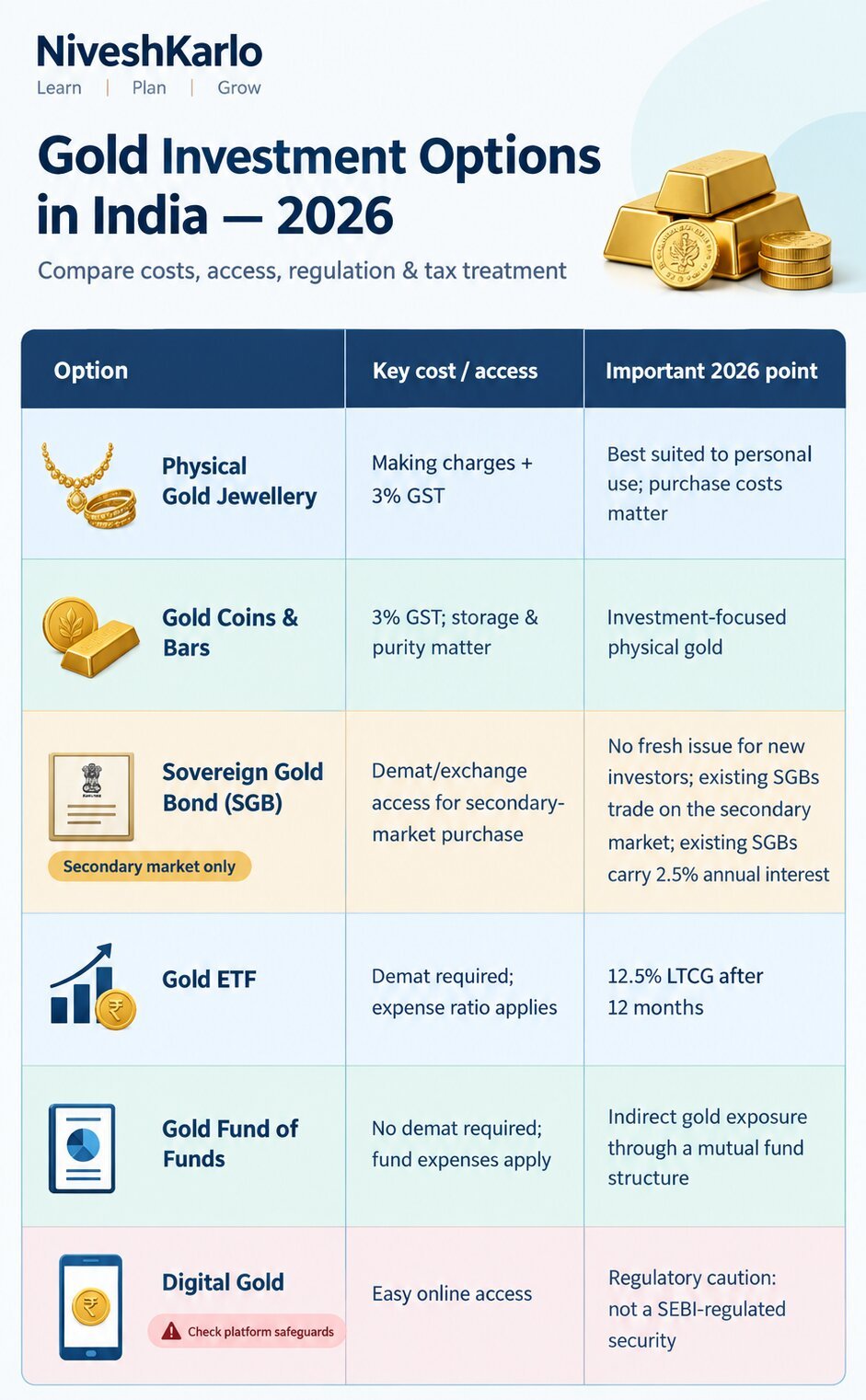
Image Source: AI
Tax treatment — where each option stands in 2026
| STCG (short-term) | LTCG (long-term) | Interest income | |
| SGB — original primary subscriber, held 8 years | N/A | Zero — fully tax-free at maturity | Taxed at slab rate |
| SGB — secondary market buyer | Slab rate (under 12 months) | 12.5% (after 12 months) | Taxed at slab rate |
| Gold ETF | Slab rate (under 12 months) | 12.5% (after 12 months) | No interest |
| Gold FoF | Slab rate (under 12 months) | 12.5% (after 12 months) | No interest |
| Physical gold | Slab rate (under 24 months) | 12.5% (after 24 months) | No interest |
| Digital Gold | Slab rate (under 24 months) | 12.5% (after 24 months) | No interest |
Tax rates per Finance Act 2024, applicable FY 2026-27. Note the key difference: Gold ETF and Gold FoF qualify for LTCG after 12 months, while physical gold and digital gold require 24 months. For investors planning to hold for 1–2 years, this distinction matters.
What to actually do — based on your situation
The answer changes depending on where you are right now.
- You hold existing SGBs from primary issuance: Hold to maturity. The combination of 2.5% annual interest plus zero LTCG tax at maturity cannot be replicated. Only exit early for genuine financial need — the premature redemption price may also be below what you’d receive at maturity.
- You have zero gold exposure and want to start: Build to 5–10% of your portfolio via monthly Gold ETF purchases or a Gold FoF SIP. Don’t put everything in at once at current prices. The same rupee cost averaging logic that works for equity SIPs applies here.
- You already have 5–10% in gold: Nothing to do. Rebalance annually. If gold’s rise has pushed it to 15–20% of your portfolio, trim back to 10% and move the proceeds into equity. That is what rebalancing is for.
- You’re thinking of buying because gold went up 50%: That is a reason to be cautious, not a reason to buy more. The 38% 1-year return was driven by one-off policy events, not structural gold demand. Your emergency fund and equity SIP deserve priority before adding more gold.
- You need gold for a wedding or ceremony: Buy BIS-hallmarked jewellery (HUID hallmark). For the investment portion of a wedding purchase, gold coins or bars have lower premium (2–5%) than jewellery making charges (15–25%). You can convert coins to jewellery later.
- You don’t have a demat account: Gold FoF is the answer. Same underlying exposure as Gold ETF, no demat needed, SIP available from ₹500/month.
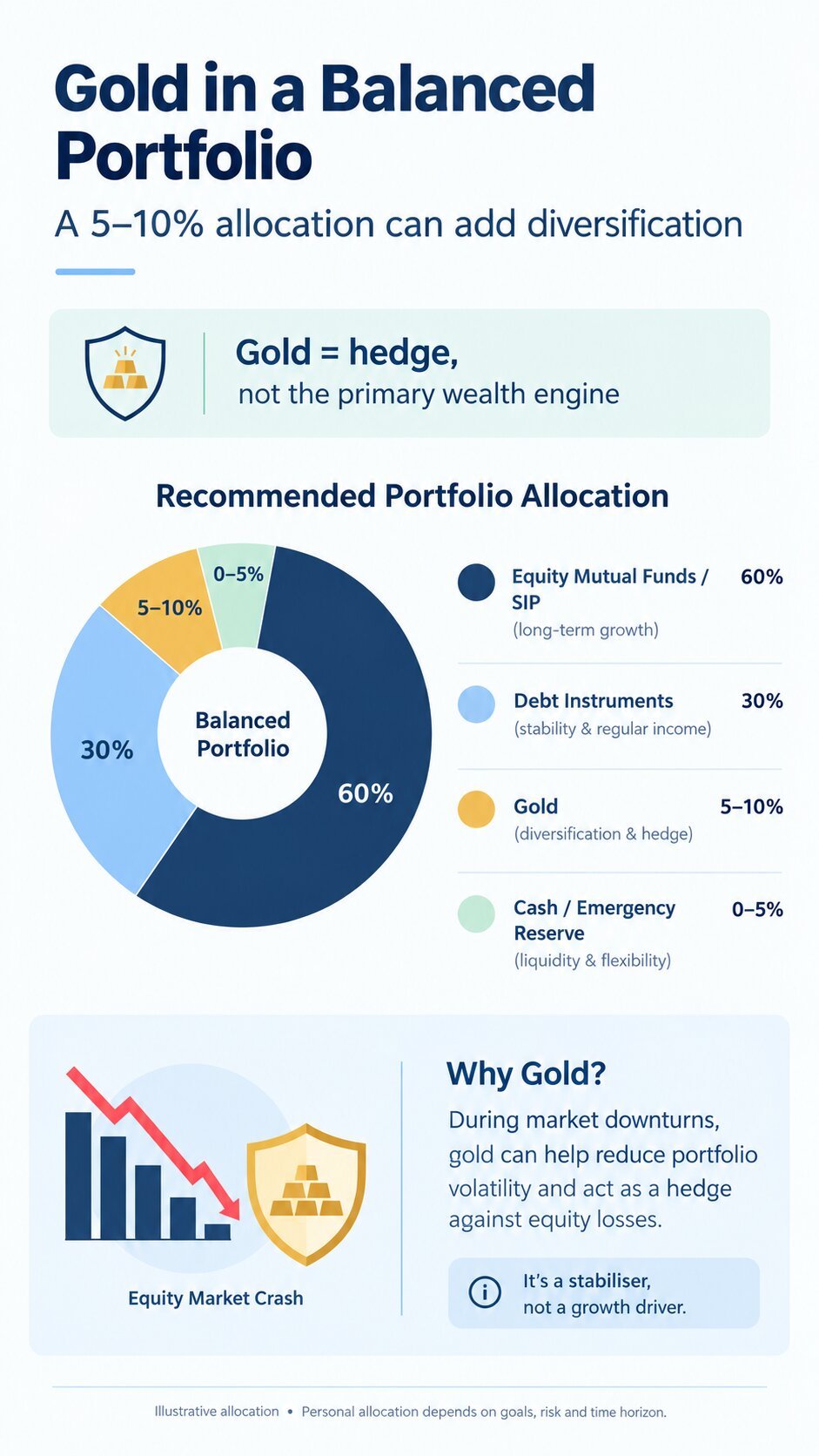
Image Source: AI
Also Read: Best Investment Plan for 5 Years | Where to Park Money for a Few Days, Months, or Years
Questions people ask about gold investment in 2026
Are Sovereign Gold Bonds still available?
Not from the government. New SGB issuances stopped in February 2024. Budget 2025 confirmed no new tranches are planned. You can buy existing SGBs from other investors on NSE or BSE, but Budget 2026 removed the tax-free maturity benefit for secondary market buyers. Secondary market SGBs also trade at 1–3% premium to gold price and have thin liquidity on many series. For new investors, Gold ETF is the more practical option.
Is Gold ETF better than physical gold?
For any amount above ₹10,000 meant purely for investment, yes. No making charges, no GST on purchase, 99.5% purity guaranteed, full liquidity on the exchange, and LTCG kicks in after 12 months (vs 24 months for physical gold). Physical gold makes sense for jewellery, ceremonies, and gold loans not as a financial instrument competing with an ETF.
Which Gold ETF has the lowest expense ratio in 2026?
Among large-AUM funds, Axis Gold ETF (0.49%) and ICICI Prudential Gold ETF (0.50%) currently have the lowest expense ratios. Tracking error matters as much as expense ratio — a fund with slightly higher expense ratio but lower tracking error may deliver better net returns. Check both before choosing. Since all Gold ETFs track the same gold price, the primary selection criteria are low expense ratio, low tracking error, and large AUM from a reputable fund house.
Can I do a SIP in gold?
Yes — two ways. Gold ETF SIPs are available on most trading platforms (Zerodha, Groww, Angel One) where you can set a monthly purchase instruction. Alternatively, a Gold Fund of Funds (Gold FoF) supports standard mutual fund SIPs without requiring a demat account, available on Kuvera, Groww, or MF Central from as low as ₹500/month. The Gold FoF has a slightly higher expense ratio than the underlying ETF but is more convenient for investors who prefer the standard mutual fund experience.
What about Digital Gold from PhonePe or Paytm?
Digital Gold is convenient for micro-amounts (under ₹10,000) and gifting. For meaningful investment amounts, it has two problems: it is not regulated by SEBI or RBI (unlike Gold ETFs or SGBs), and the 24-month holding period for LTCG same as physical gold is longer than Gold ETF’s 12 months. Storage charges of 0.5–0.6% per year also kick in after a few months. Gold ETF or Gold FoF is a better vehicle for any serious gold allocation.
Gold is at an all-time high. Will it fall from here?
Nobody can reliably predict short-term gold prices not in either direction. The 1-year return of ~38% was driven by India’s import duty hike (6% to 15% in May 2026) and rupee depreciation both one-off events that are not likely to repeat at the same scale. By mid-June 2026, prices had already pulled back from the peak. Whether gold rises or falls from current levels depends on global factors (Fed rate decisions, geopolitical events, central bank buying) that are inherently unpredictable. This is exactly why gold is bought as a 5–10 year portfolio hedge not as a short-term return trade. If a 15–20% fall in gold price would disturb you, you are holding too much of it. See how the same logic applies to equity in our guide on what happens when markets fall.
Gold at current prices is not cheap, but that is rarely the right frame. The question is whether your portfolio has a 5–10% allocation to an asset that holds its value when equity doesn’t. If you have zero gold exposure and significant equity, a Gold ETF or Gold FoF SIP built up over 6–12 months is worth considering. If you’re already at 10%, leave it and rebalance annually. And if you held SGBs from primary issuance you’re sitting on one of the best investments made available to retail investors in recent years. Hold them.

Hello there, my name is Phulutu, and I am the Head Content Developer at Nivesh Karlo. I have 13 years of experience working in fintech companies. I have worked as a freelance writer. I love writing about personal finance, investments, mutual funds, and stocks. All the articles I write are based on thorough research and analysis. However, it is highly recommended to note that neither Nivesh Karlo nor I recommend any investment without proper research, and to read all the documents carefully.