How to Stop a SIP: All Methods, One Clear Guide

Via broker app, AMC website, MF Central, or bank NACH cancellation — including the step that most articles skip, which is the one most likely to cause problems.
Transparency: AI-assisted rewrite reviewed by the NiveshKarlo team. All platform steps and MF Central process verified June 24, 2026. Informational only — not investment advice.
Stopping a SIP is straightforward — but there is one step that a significant number of people miss, and it results in their bank account being debited for months after they think the SIP has been cancelled. That step is the NACH mandate. This guide covers all four ways to stop a SIP, the NACH mandate step for each, and — before you do any of this — three questions worth answering first.
Before you stop — three questions worth a minute of your time
Most people who search ‘how to stop SIP’ are reacting to something: a market fall, a tight month, a feeling that the investment is not working. Some of those reasons are sound. Some are worth examining before acting, because stopping a SIP has a cost that is not immediately visible — as we covered in detail in our article on the power of SIP over time.
1. Is the market fall the reason?
If you are stopping because markets are down and your portfolio is showing a loss, it is worth reading what actually happens to your SIP when the market falls before deciding. Every major market downturn in the last 35 years has been followed by a recovery, and SIP investors who stopped during the fall missed the cheapest unit purchases of their investment cycle. A pause rather than a permanent stop is worth considering here.
2. Is it the fund, or is it the markets?
If the SIP is underperforming, the reason matters. A fund that has underperformed its benchmark consistently for 3+ years across market cycles is a different problem from a fund that is down because its benchmark index is down. Stopping the SIP without evaluating this conflates two different issues. Our guide on how to analyse a mutual fund walks through how to assess whether the underperformance is fund-specific or market-wide.
3. Could a pause or step-down solve it?
If a cash crunch is the reason, most platforms allow you to pause a SIP for 1–3 months without cancelling it. This keeps the investment running after the pause ends without you needing to restart. Alternatively, if the issue is that the SIP amount feels too high, stepping it down — reducing the monthly amount — is available on most platforms without stopping. See our guide on how to increase your SIP amount over time which also covers reducing it.
| If after these three questions you still want to stop — proceed below. The rest of this article covers all four methods clearly. |
The step most people miss: the NACH mandate
This is the section that most SIP cancellation guides mention in passing and then move on from. It deserves its own space because it is where the majority of post-cancellation problems come from.
When you set up a SIP, two things are created simultaneously: the SIP instruction with the AMC, and a NACH (National Automated Clearing House) auto-debit mandate with your bank. The SIP instruction tells the fund when and how much to invest. The NACH mandate tells your bank to allow those automatic debits.
When you cancel a SIP through a broker app or AMC website, the SIP instruction is stopped. But the NACH mandate at the bank is a separate registration — and in most cases, it does not get cancelled automatically when you stop the SIP. If you forget to cancel it separately, your bank may continue to receive debit requests. These will likely fail (since the SIP instruction is gone), but some banks still charge a return payment fee for failed mandate attempts.
| What to do after cancelling your SIP on any platform: Log in to your bank’s net banking portal → go to ‘Auto Debit Mandates’ or ‘Standing Instructions’ → find the SIP mandate → cancel or deactivate it. Alternatively, visit your bank branch with the mandate details and request cancellation. If no debit attempt occurs for 2–3 consecutive months, most bank mandates expire automatically — but manually cancelling is cleaner and avoids any ambiguity. |
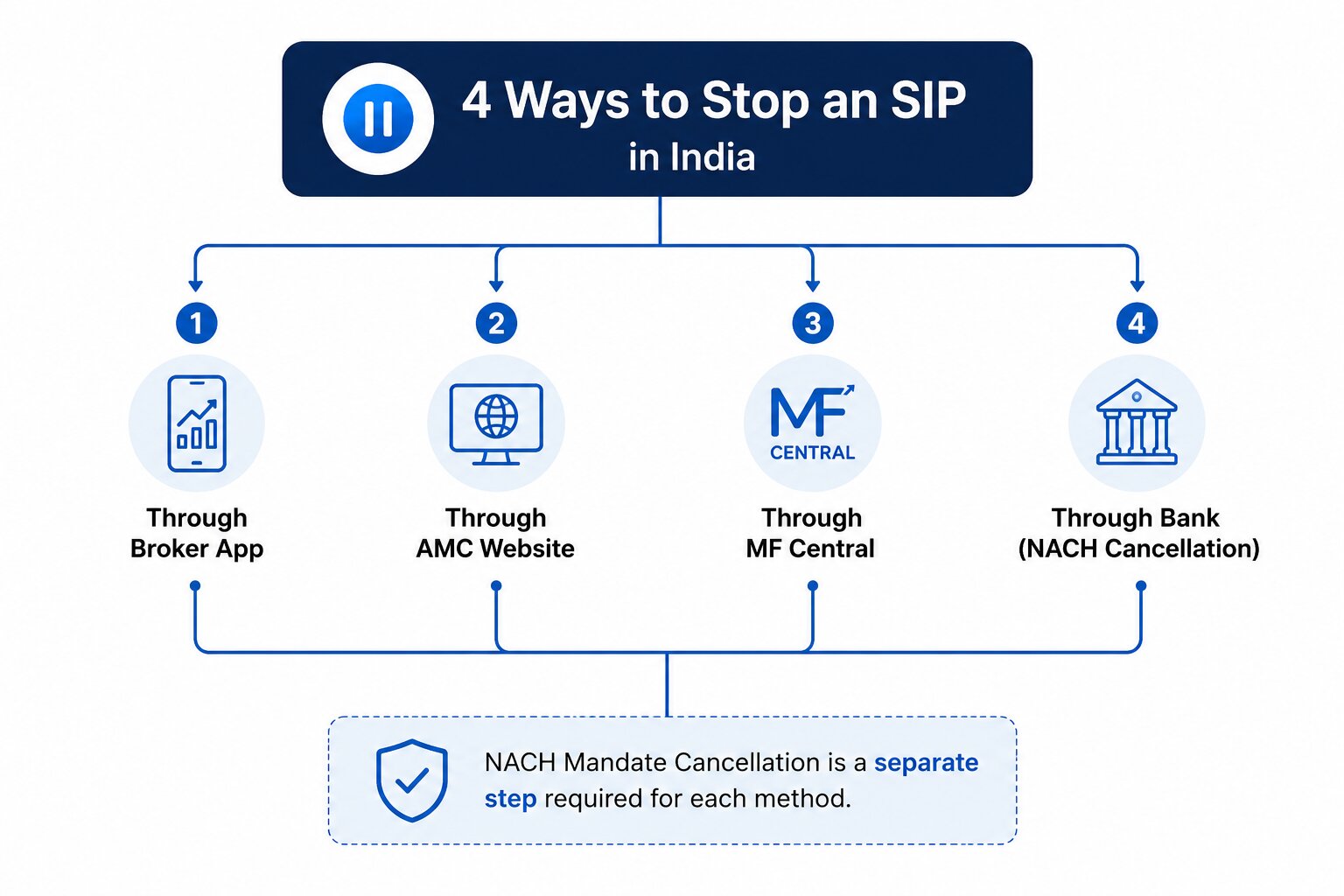
The four ways to stop a SIP — step by step
Method 1: Through your broker or investment app
This is the fastest method if you invested through Groww, Zerodha Coin, Paytm Money, ET Money, or any other third-party platform. The process is similar across platforms:
- Log in to your investment app or platform.
- Go to ‘SIP Instructions’, ‘Active SIPs’, or ‘Investments’ — the label varies by platform.
- Select the SIP you want to cancel.
- Tap ‘Cancel SIP’, ‘Stop SIP’, or ‘Delete SIP’.
- Confirm the cancellation when prompted — most platforms send an OTP.
- You will receive a confirmation via email or SMS, usually within a few minutes.
- Important: Cancel the NACH mandate separately through your bank (see Section 2 above).
| Timing note: If your SIP date is within the next 7 working days, the cancellation may not take effect until the following month’s instalment. Most platforms show you the effective date when you initiate the cancellation. Check this before assuming the current month’s debit will not go through. |
Method 2: Through the AMC’s website directly
If you invested directly through the fund house’s website — HDFC Mutual Fund, SBI Mutual Fund, Nippon, Mirae, or any other AMC — cancellation is done through your registered account on their portal:
- Log in to the AMC’s website using your credentials or OTP.
- Navigate to ‘My Investments’, ‘SIP Details’, or ‘Transaction History’.
- Locate the SIP and select ‘Cancel’ or ‘Stop SIP’.
- Submit the cancellation and note the confirmation reference number.
- Cancel the NACH mandate at your bank separately.
The AMC typically processes cancellations within 1–2 working days and sends a confirmation. Keep the reference number until you have confirmed that the next SIP instalment was not processed.
Method 3: Through MF Central
MF Central is a joint platform by CAMS and KFintech — the two largest mutual fund RTAs in India — that allows you to manage SIPs across multiple AMCs from a single login. This is particularly useful if you have SIPs in different fund houses and want to manage them in one place.
- Visit mfcentral.com and log in using your PAN and registered mobile number or email.
- Select your folio from the dashboard.
- Click on ‘Service Requests’ → ‘SIP Cancellation’.
- Select the specific SIP and confirm via OTP.
- You will receive a cancellation confirmation from the respective AMC.
- Cancel the NACH mandate separately through your bank.
MF Central is SEBI-mandated and registered, making it a reliable option for investors who prefer not to deal with each AMC’s portal individually. It also allows you to pause, modify, or change the bank mandate for existing SIPs — not just cancel them.
Method 4: Through your bank (NACH cancellation only)
If your SIP was set up through an offline form or directly via bank branch, or if you want to stop the SIP by cancelling the auto-debit mandate rather than submitting a formal SIP cancellation request, you can do so through your bank’s net banking portal or branch.
- Log in to your bank’s net banking portal.
- Go to ‘Auto Debit Mandates’, ‘Standing Instructions’, or ‘Manage Mandates’.
- Find the mandate linked to your SIP — it will typically show the AMC’s name and the debit amount.
- Select ‘Cancel’ or ‘Deactivate’.
- Confirm the cancellation.
| Important: Cancelling the NACH mandate at the bank stops the auto-debit but does NOT cancel the SIP instruction at the AMC. If you later set up a new mandate, the SIP instruction may resume. To fully cancel the SIP, also submit a cancellation through the AMC’s website or MF Central. |
Pausing a SIP vs stopping it — and why the difference matters
Most major platforms — Zerodha Coin, Groww, MF Central — now allow you to pause a SIP for 1, 2, or 3 months without cancelling it. When the pause period ends, the SIP resumes automatically without you needing to set it up again.
| Pause SIP | |
| What it does | Skips 1–3 monthly instalments |
| Units accumulated | Unchanged — existing units stay in your folio |
| Auto-resume | Yes — SIP resumes after the pause period |
| NACH mandate | Stays active — auto-debits resume after pause |
| Best for | Temporary cash crunch, market uncertainty |
The practical implication: if you are pausing because of a short-term cash crunch, use the pause feature rather than a full cancellation. Restarting a cancelled SIP requires setting up a new SIP instruction and a new NACH mandate — which takes 20–30 days to activate. A pause avoids this entirely. If you are stopping because your financial goal has been achieved or because you are exiting the fund permanently, a full cancellation is the right choice — but remember to cancel the NACH mandate separately.
What happens to your existing units when you stop a SIP
Stopping a SIP does not automatically redeem your existing units. The accumulated units remain in your folio, and their value continues to change with the fund’s NAV — going up or down with the market.
You have three options for the existing units after stopping the SIP:
- Stay invested: Leave the units in the fund. They continue to grow (or fall) with the market. If your original reason for stopping was a market fall, this is often the better choice — the units you accumulated during low-NAV months are now positioned to benefit from the eventual recovery.
- Redeem partially: Withdraw a portion of the units if you need liquidity, and leave the rest invested. Partial redemptions are available through your platform or AMC portal.
- Redeem fully: Submit a full redemption request. The units are sold at the current NAV, and the proceeds are credited to your registered bank account within 2–3 working days for equity funds and 1 working day for liquid funds. Check for applicable exit loads (typically 1% for redemptions within 12 months) and capital gains tax implications before redeeming.
Questions people ask when stopping a SIP
Does stopping a SIP automatically redeem my mutual fund units?
No. Stopping a SIP only cancels the future automatic investments. Your existing accumulated units remain in your folio and continue to be valued at the daily NAV until you actively choose to redeem them. You can redeem partially or fully at any time through your platform or AMC portal.
How long does it take for a SIP cancellation to take effect?
Most broker apps and AMC platforms process the cancellation within 1–2 working days and send a confirmation. However, if your SIP date falls within the next 7 working days from the date of cancellation, that month’s instalment may still go through. Always check the effective date shown at the time of cancellation, and verify with your bank statement that the next expected debit did not occur.
What is a NACH mandate and do I need to cancel it separately?
NACH (National Automated Clearing House) is the mechanism that allows your bank to automatically debit your account for SIP instalments. When you cancel a SIP through a broker app or AMC website, the SIP instruction is stopped — but the NACH mandate at the bank often remains active as a separate registration. Cancel it through your bank’s net banking under ‘Auto Debit Mandates’ or ‘Standing Instructions’ to avoid failed debit attempts and potential bank charges.
Can I stop a SIP mid-tenure without any penalty?
SEBI regulations do not permit AMCs to charge a penalty for stopping a SIP before its scheduled end date. There is no exit load or penalty for cancelling the SIP instruction itself. However, if you also redeem your existing units within the exit load period (typically within 12 months for equity funds), the exit load applies to the redemption — not to the SIP cancellation.
What happens if I stop a SIP because the fund is performing poorly?
Before stopping for this reason, check whether the underperformance is fund-specific or market-wide. A fund that has consistently underperformed its benchmark index (e.g. Nifty 50 for a large-cap fund) over 3+ years may warrant a switch. A fund that is down because the broader market is down is a different situation. Our guide on how to analyse a mutual fund covers how to evaluate this distinction.
Can I restart a SIP after stopping it?
Yes — but you will need to set up a new SIP instruction and a new NACH mandate, which typically takes 20–30 days for the mandate to activate and the first debit to go through. If your reason for stopping was temporary (cash crunch, market uncertainty), using the pause feature instead avoids this delay entirely. To restart after a full cancellation, follow the same process as starting a new SIP.
One final check before you confirm
Once you submit the cancellation, you will receive a confirmation from your platform or AMC. Keep this confirmation until you have verified two things: that the next expected SIP debit did not go through, and that you have cancelled the NACH mandate at your bank. Both checks take less than five minutes and prevent the most common post-cancellation problems.
If you are stopping the SIP but not redeeming the units yet, make a note in your calendar to review the fund’s performance in 3–6 months. The decision to redeem or stay invested is separate from the decision to stop contributing — and for many investors, the best outcome is to stop the SIP but keep the existing units invested until the market conditions or personal circumstances warrant a full exit.
Disclaimer: This article is for educational and informational purposes only. Platform steps are illustrative — exact navigation may vary by app version or platform update. All SIP cancellation processes are subject to the policies of the respective AMC and platform. Exit loads and capital gains tax implications apply to unit redemptions, not to SIP cancellations. NiveshKarlo does not endorse any specific mutual fund platform or AMC. Please consult a SEBI-registered investment advisor for guidance specific to your situation.

Hello there, my name is Phulutu, and I am the Head Content Developer at Nivesh Karlo. I have 13 years of experience working in fintech companies. I have worked as a freelance writer. I love writing about personal finance, investments, mutual funds, and stocks. All the articles I write are based on thorough research and analysis. However, it is highly recommended to note that neither Nivesh Karlo nor I recommend any investment without proper research, and to read all the documents carefully.